
You are on eastlansinginfo.org, ELi's old domain, which is now an archive of news (as of early April, 2020). If you are looking for the latest news, go to eastlansinginfo.news and update your bookmarks accordingly!
You are on eastlansinginfo.org, ELi's old domain, which is now an archive of news (as of early April, 2020). If you are looking for the latest news, go to eastlansinginfo.news and update your bookmarks accordingly!
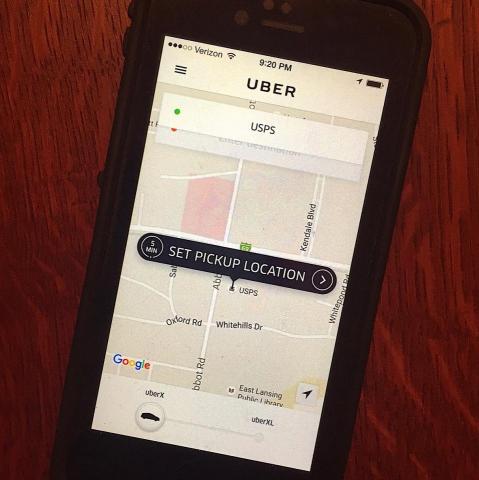
ELi reported on Saturday that the East Lansing Police Department (ELPD) had opened an investigation into two reports by female MSU students of being subject to “unwelcome sexual advances towards them” by drivers of a rideshare service. In response, social media lit up with disagreements, with Uber fans objecting to the ELPD’s implication that conventional taxi services are safer than Uber, and detractors questioning why anyone would use the service. (Uber is the largest rideshare service, so that is why discussion focused on that company.)
As a follow-up, yesterday I asked the spokesperson for the ELPD, several local Uber drivers, and local Uber riders about their perceptions regarding the service. I also downloaded the Uber app to my smartphone and used the service for the first time.
How online ridesharing works: Services like Uber, Lyft, and Sidecar all operate using smartphones. They allow people who need a ride to hire the driver of a private car to take them to their destination. Here’s a concrete example of how this works:
I used Uber yesterday evening to request a ride from the East Lansing Post Office on Abbot Road to Foods for Living on Grand River Avenue. I plugged in where I was and where I wanted to go. The service immediately offered me a driver who was about one minute away and indicated the ride would cost me about $6.40.
On my phone, I could see the driver’s name, his photo, car make, and his rating from other riders. The driver offered to me, whom I’ll call Bob, had a rating of 4.7 out of 5. If I didn’t like the look of Bob on my phone, Uber would have allowed me to “reject” him and look for another option in the area.
If Bob and his car had not matched what Uber told me I should expect when he arrived, I would not have gotten in the car. It all did match. Bob picked me up within about 60 seconds of when I requested the ride from the service. I got into the back of his car, buckled up, and we chatted as he drove me to my destination. He told me he has been driving for Uber for about six weeks and has been doing it to save up money for a vacation. He looked to be about 55-60 years old and told me he grew up in East Lansing and still lives in the area.
When we got to my destination, Uber charged the credit card I had earlier put into the system for the amount the service told me before the ride it would cost. (There’s no tipping with Uber.) Afterwards, Uber asked me to rate Bob as my driver, and Bob was asked to rate me as a passenger. These ratings will be visible to other drivers and riders as they decide whether to do business with each other in the future.
If I had needed to call my driver before he arrived, the Uber system would have let me do so through the app. Bob could also have called me—for example, if he had arrived at my stated location and did not see me. The Uber app doesn’t give us each other’s phone numbers; rather, it routes the call for you without giving away the phone number.
Uber’s safety systems: Uber requires that all individuals who wish to drive with the service submit to a number of background checks, including an examination of their driving history and criminal records. Uber also checks on the driver’s insurance and car registration. They require a relatively new make of car (in Michigan, 2004 or later).
Riders who feel a driver or car is unsafe can report the situation to Uber. Uber may pull the driver from the system while the company investigates the complaint. When, during an ice storm, one local Uber driver’s car went off the road, the passenger reported it to Uber and Uber suspended the driver until it could determine that the driver was not at fault and the car was not damaged.
Uber drivers are paid only through the electronic system and therefore are not known to be carrying any cash, which makes them less susceptible to potential robbers compared to conventional cab drivers.
Uber tracks each ride using the driver’s and rider’s cell phones. (When you sign up for Uber, you agree to let the company track you while you are in the car.) This means that, were a rider to go missing, Uber would have the records of where the phones in the car went. Additionally, riders can use their smartphone to allow friends or family to track where they are along the way. Riders can also watch as their driver approaches, which means they can stay inside a building until their ride arrives.
ELPD’s perception of rideshare services: ELPD’s announcement of their investigation included the statement: “ELPD would like to make sure that the public is aware that rideshare services do not undergo the same regulatory procedures as traditional taxi companies with the Greater Lansing Taxi Authority.” This would seem to suggest that conventional taxis working with the Greater Lansing Taxi Authority are safer than services like Uber.
Yesterday I asked ELPD spokesperson Lieutenant Scott Wriggelsworth to elaborate on those regulatory procedures. He said that before a driver can work within the Greater Lansing Taxi Authority, the driver must submit to a background check “to make sure they are able to drive the cabs safely.”
Wriggelsworth was unfamiliar with the background checks done by Uber. After I explained it, he said that the police could do a more thorough check than Uber because they can look for open criminal charges, whereas a company like Uber could only check for standing criminal convictions. He also said it is likely the ELPD would have greater resources for more complete checks. The police can use its record-searching abilities, he said, to check whether an applicant’s answers on the application to the Greater Lansing Taxi Authority are true.
Wriggelsworth noted that, according to news reports, the Uber driver in Kalamazoo who was driving around murdering people did not have a criminal record, so he would likely not have been stopped from being allowed to drive by the Greater Lansing Taxi Authority. Said Wriggelsworth, “the background check doesn’t necessarily mean we catch everything.” But, he said, the background check “might take someone off the road who doesn’t have a strong moral character and shouldn’t be driving anyone around.”
What’s the perception by Uber riders? Yesterday, I asked three Uber riders, all people I have not met before, about why they use Uber and how safe they feel. I’m using pseudonyms for them here.
Becca is a nineteen-year-old woman who is a full-time student at MSU and works part-time. She said she uses Uber because it is “exponentially cheaper than taxi services, and extremely accessible via my smart phone. Only downside is the surge pricing. In which case, I would probably call a taxi service if available.” (“Surge pricing” means that the charge for Uber rides goes up during busy times. The increased charge is shown when you ask for a ride.) Becca says she uses Uber “when I am running late to work, or when the buses aren't running (mostly on weekends or early mornings).”
She says she “was very unsure about Uber, and only started to use it when I had to open at work early in the morning. My experiences have all been pretty pleasant, and all of them have been with older men, except one who was a guy only slightly older than me. The fact that it was mostly men (as a female), was unsettling and made me nervous my first couple of rides. The shooting in Kalamazoo has made me hesitant to use Uber again, but I probably will if necessary.”
Jamie is a twenty-year-old MSU student “that usually only ever uses Uber for going out on the weekends.” Jamie said she likes Uber “because I can see on the app exactly where my ride is at and don't have to stand outside and wait (especially in the cold). I can see who my driver is and their make/model of car. I also don't have to worry about having cash as you pay through the app.”
She said she feels safe with the service “because everything is digitalized and the driver's actions (pickup/drop off) are all being documented more so than a regular taxi driver. However, I've only done it with others and might feel less comfortable by myself.”
Jim is 35 years of age and identifies himself as a “working professional with family.” He says he uses Uber “for rides to the airport so I don’t have to leave a car and for nights out at the bar.” (Based on my investigations, Uber is frequently used as a “designated driver” by people in East Lansing.)
Jim says, “I love to use Uber because of its app. I love being able to see where cars are and how long until they will be there to get me. Being able to check the fare before even ordering a ride is wonderful.” He adds, “I have always felt safe in an Uber. The drivers have always been courteous and helpful.”
One driver’s perception: Yesterday I also spoke to Francine, an Uber driver whom I’ve not met, about her perceptions regarding the safety systems of Uber. She has been driving for Uber for about five months and likes the flexible, part-time work it offers as she pursues a graduate degree. She said she generally feels safe driving for Uber because of all the safety systems built in. She told me she was impressed with all the background checks Uber did before allowing her to drive. She is also very aware that riders’ ratings of her driving will directly impact whether she gets more work.
Francine says that with a conventional cab service, a customer may call and then wait and wait, and that there is no way to know who your driver will be. She believes Uber is faster and safer for customers, but also safer for her as a driver, because Uber has so much information about their customers, including their cell phone and credit card information. That means that if a customer were to assault a driver, odds are Uber could figure out who it was, unless the phone was stolen.
Francine told me she often picks up MSU students who have been drinking and who therefore should not be driving, and that she appreciates keeping them off the road and helping them get home safely. She told me, “They’d rather pay for Uber than a DUI.” She often elects to work late nights and picks up many students from downtown bars to take them home.
Have a question you want ELi to investigate? Contact us!
Disclosure: ELi’s Managing Editor, Ann Nichols, has a family member who drives for Uber.
Post-publication we corrected the spelling of Lieutenant Scott Wriggelsworth's name. ELi regrets the error.
eastlansinginfo.org © 2013-2020 East Lansing Info