
You are on eastlansinginfo.org, ELi's old domain, which is now an archive of news (as of early April, 2020). If you are looking for the latest news, go to eastlansinginfo.news and update your bookmarks accordingly!
You are on eastlansinginfo.org, ELi's old domain, which is now an archive of news (as of early April, 2020). If you are looking for the latest news, go to eastlansinginfo.news and update your bookmarks accordingly!
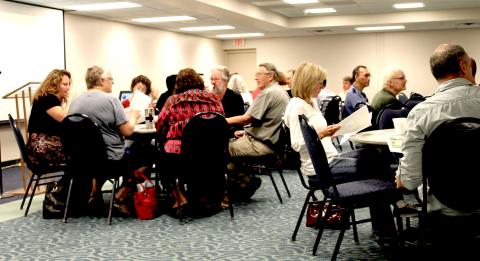
About a hundred citizens, including business- and home-owners and MSU urban planning students, turned out over the course of two meetings last night and this morning to discuss what to do with the properties in the area formerly known as "City Center II." The City, which hosted the meetings, is now calling the area the "Park District Planning Area." The meetings were held on September 6 at 7 pm, and on September 7 at 9 am, both at the Hannah Community Center.
The meetings were relatively short for this big issue -- just over an hour each. Thursday evening's session included about 75 people, including about 10 staff; Friday morning's had about 40 people, including about 7 staff. The only City Council member in attendance was Kevin Beard, who attended the morning session.
The discussions were highly structured. Although it was not discussed in the large group, in many of the small-group discussions some confusion existed with regard to how the city can really move forward on the properties that the DDA (Downtown Development Authority) owns without knowing what the private developers who own the other properties will do with their land. (See the map here to understand who owns what.)
Because the publicly- and privately-owned properties are so intertwined, with the privately-owned lots being the most important in terms of location, it is difficult to know how the city can move forward unless (a) the city proposes a project with which the private owners wish to cooperate, or (b) the city comes up with a plan that is doable and sustainable regardless of what happens to the private buildings. In an interview I conducted with her during the morning small group discussions, senior project manager Lori Mullins acknowledged this difficulty.
In a separate conversation, citizen Eliot Singer told ELi, "There may be some good ideas for redevelopment, such as an MSU-affiliated retirement community some have been bandying about, but they would all include the private properties. Doing an RFP [request for proposals] before dealing with the [privately-owned] buildings on Grand River makes no sense."
Nevertheless, city staff made clear that they want to produce a finalized Request for Qualifications/Proposals (RFQ/P) by late October. To achieve this deadline, staff would have to produce a draft RFQ/P and run it by the public, the DDA, and City Council in a little over one month.
In his introductory remarks, city manager George Lahanas spoke of the importance of moving forward in vision. Mullins then presented a quick overview of the area, including with regard to ownership and debt. The public owes about $5.6 million in bonds on the properties along Evergreen Avenue which were originally purchased in order to provide a parking structure for City Center II. Those properties are now estimated to be worth only about one-third of what is owed on them. The building at 303 Abbot is also in poor shape financially and structurally.
I asked Mullins in our interview how we can manage being "underwater" this far. She explained that the properties may be sold at a loss and then combined with DDA TIF to try to recoup the losses. In her presentations at the meetings, Mullins was frank that the debt is a significant constriction on what we can realistically build. Mullins also noted the constrictions caused by the fact that several of the properties and part of the street are in the Historic District (although this is easily overcome if the Historic District Commission agrees to whatever plan goes forward).
Mullins spoke of seeking not only proposals, but proof of developers' qualifications, considered by many a step forward in Planning after the long-drawn-out and expensive City Center II collapse.
Certain ideas and values came up again and again among citizens. Most wanted to protect or even expand Valley Court Park. Many wanted a grocery store. Other common wishes included upscale restaurants, walkable green space, easy bike access, adequate parking, residences that could span generations, residences for older citizens, residences for alumni, a movie theatre (perhaps of the art type), and a boutique-type hotel. People spoke to the importance of honoring Peoples Church and its needs, and also respecting the needs of Oakwood, the neighborhood on the north side of the area. Some wanted to try to draw high-tech industry. Some suggested meaningful partnership with MSU.
Although the mood was generally cordial and upbeat, residents I talked to afterwards were more guarded in their optimism. Several who did not wish to be named wondered aloud if they were being used by the city as statistics to claim that "100 citizens were heard," when in fact the meetings were very short and very structured, and not conducive to a discussion of how we will avoid making the costly mistakes made before in this area.
Planning Director Tim Dempsey closed the meetings by encouraging all to transmit their ideas, preferably in writing, to the City and to stay engaged in the process as it moves quickly forward.
For extensive notes on the meetings, see this page. To see the properties we are talking about, see this page. For the complete interview with Lori Mullins, go here.
eastlansinginfo.org © 2013-2020 East Lansing Info