
You are on eastlansinginfo.org, ELi's old domain, which is now an archive of news (as of early April, 2020). If you are looking for the latest news, go to eastlansinginfo.news and update your bookmarks accordingly!
You are on eastlansinginfo.org, ELi's old domain, which is now an archive of news (as of early April, 2020). If you are looking for the latest news, go to eastlansinginfo.news and update your bookmarks accordingly!
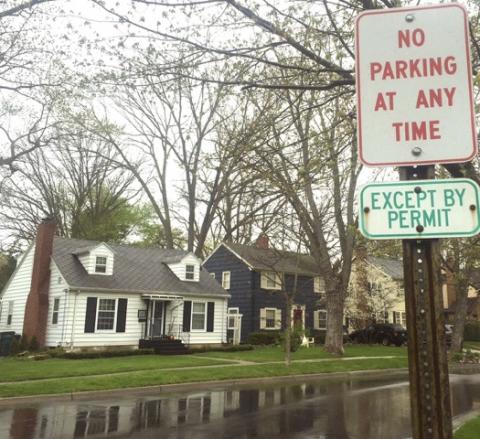
This week’s East Lansing City Council meeting was again dominated by the issue of residential parking permits (RPP). The issue was ultimately resolved by a unanimous Council vote in favor of a new version of the review and approval process for designating residential sections of the City as permit-only parking.
The permit issue originally arose in the Chesterfield Hills neighborhood after the Chesterfield Hills Neighborhood Parking Committee petitioned the City for more restricted (e.g., permit-only) parking on some streets. In response, other residents of the neighborhood vocally opposed both the proposed restrictions as well as the process by which they were brought to the City.
As ELi reported, on January 5 of this year, Council voted 3-2 to expand permit-only parking in Chesterfield Hills by establishing Ordinance No. 1370. On Tuesday night, after considering input from the City’s Transportation Committee and Councilmembers Shanna Draheim and Erik Altmann, Council voted unanimously to adopt a version of the so-called “Draheim B” version of the Ordinance.
Despite the fact that the Ordinance itself was already previously approved by Council, citizens made it clear in written and verbal communications that strong feelings remained. Mayor Mark Meadows indicated that most of the written communications received prior to Tuesday night’s meeting concerned residential parking and came from Chesterfield Hills resident Diane Wing, Red Cedar resident Joanne Russell, and Bailey resident Sally Silver. All three women have served as presidents of their respective neighborhood associations.
Silver told Council that Council responding to complaints about RPP in Chesterfield Hills is ultimately resulting in negative impacts for existing RPP neighborhoods. “Why remove neighborhood associations [from the process]?” she asked, saying that removing the associations “makes it much harder to get an RPP.”
At the podium, Wing asked Council to deny proposed amendments to Ordinance 1370 amendments “and appoint a committee to get us to greater consensus.” She also said that revisions had been made to the draft ordinance since the weekend, and that the changes were “cherry-picked” to appease a small group that wants neighborhood association taken out of the permit-issuance.
Jack Roberts of Chesterfield Parkway stated that he favors the first version of the Ordinance because it was based on two meetings of the traffic commission.
Ben Fedewa, also of Chesterfield Parkway, said he was “distressed and amazed” that Council might be called on to vote on Ordinance 1370 “in the shape it’s in.” He advised “data-based” decision making, and leaving some decisions in the hands of neighborhood groups because “City Hall can’t do everything.”
Tom Caulder explained to Council that he “lives on same street as Ben Fedewa,” that there have been no cars parked where Fedewa lives, and that Fedewa’s “notion that the whole City is going to hell is a waste of time.” He went on to say that the Chesterfield Hills Neighborhood Association was “like a fiction” and that he and some of his neighbors had been “blindsided” to discover that the Association had submitted a request for increased permit parking.
After more than one reference to the confusion caused by multiple versions of the Ordinance on the City’s website, Beier noted how confusing it is for people “trying to follow along at home.” Meadows agreed that it was confusing, adding that as a Council they “got ahead of ourselves” and “may not adopt any of these [versions of Ordinance 1370].”
At the close of public comment, Draheim moved to substitute the so-called “Draheim B” version of the parking law for the existing Ordinance, with one sentence struck. Although she voted against the Ordinance initially, partially based on her experience as a resident of Chesterfield Hills, she stated that she “supports citizens’ ability to be proactive” and believes that “we also need parking restrictions to make the city better.”
She explained that the revisions she made to create “Draheim B” came from listening to public comments, RPP discussions, Transportation Commission members, her knowledge from living in lots of different places, and from her neighbors. She stressed that her intention in eliminating neighborhood associations as a necessary part of the process of requesting permit parking was not to eliminate them but to make it so they are not required to be the petitioner.
Draheim’s motion passed unanimously, and the remainder of the meeting was consumed by Council members proposing amendments to “Draheim B,” discussing the proposed changes and voting on them. The main changes have to do with the process of establishing or terminating an RPP. The most significant revision is language specifying that neighborhood associations can, as an alternative to an individual resident, initiate the RPP petition process.
Council also voted to change language requiring that “51% of returned ballots” in a proposed RPP area approve the submission of a final parking plan to Council for possible adoption; the new version instead refers to “a majority of ballots returned.” The final version also outlines the process for terminating the RPP program in a neighborhood, which includes notice to residents of the affected area and a public hearing on the issue.
The final version of Ordinance 1370 is available here.
eastlansinginfo.org © 2013-2020 East Lansing Info