
You are on eastlansinginfo.org, ELi's old domain, which is now an archive of news (as of early April, 2020). If you are looking for the latest news, go to eastlansinginfo.news and update your bookmarks accordingly!
You are on eastlansinginfo.org, ELi's old domain, which is now an archive of news (as of early April, 2020). If you are looking for the latest news, go to eastlansinginfo.news and update your bookmarks accordingly!
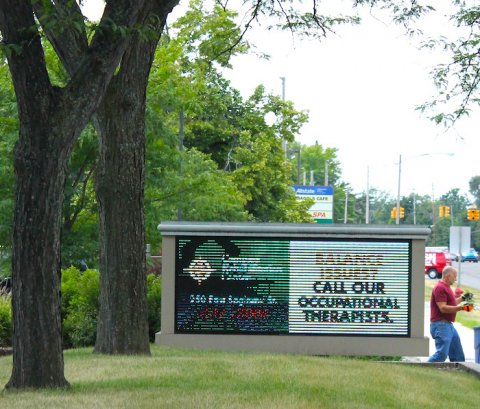
Above: A commercial electronic sign in East Lansing of the sort debated at Council.
After a lengthy revision process, East Lansing’s City Council approved an updated sign ordinance with a vote of 4-1 at its meeting last week. Mayor Mark Meadows cast the lone “nay” vote. Much discussion centered on the question of whether to allow electronic signs with displayed content that changes as much as several times per minute.
This revision to the sign ordinance was necessary to bring the City’s code into compliance with a 2015 United States Supreme Court decision which mandated that municipalities not regulate signs based on their content.
East Lansing Planning and Zoning Administrator David Haywood explained the problem created by this decision, saying, “Basically if you have to read the sign [itself] to apply the code, then you have to retool your code.”
The difficulty in creating a content-neutral code was previously discussed at the May 15, 2018, City Council work session, where Haywood and City Attorney Tom Yeadon pointed out some of the things that had had to be changed in East Lansing’s code.
For instance, real estate “for sale” signs, which are allowed temporarily while a house is for sale, can’t be referred to as “real estate signs” in the code, but are designated instead as yard signs.
Similarly, the code can’t refer to “exit and entrance signs,” such as those that might be used near a restaurant’s driveway, but instead can only designate that signs of a certain size (regardless of content) can be installed near driveways.
Removing all language that might point to a sign’s content proved to be a complicated and lengthy process.
Local business owner Dianne Holman had the only comment during last Wednesday’s public hearing on this issue. She came to say that she was pleased that the new ordinance was finally coming to a vote.
Holman’s business, Red Cedar Spirits, is located on a side street off of Haslett Road, and she has wanted to use a blue road sign from the State of Michigan’s Pure Michigan branding division to direct visitors to the distillery. She called the Council’s attention to one section of the code which, if amended as planned, would allow tourism-themed signs.
Holman outlined her frustration over the last two years, as she waited and waited to be able to arrange a Pure Michigan sign pointing to her business, and the adoption of the new code was pushed further and further out.
“We started in fall of 2015,” she said, explaining that some delays were due to problems determining right-of-way and waiting for the end of construction of the Costco store on Park Lake Road. But then, she said, she had to wait further as Council worked out the sign ordinance revision. She implored Council to pass the revision. She concluded by emphasizing how hard hurdles like this are for small businesses.
“Do they really need to be that hard?” she asked. Several Council Members appeared to be sympathetic to her request to pass the revision that night.
During the subsequent discussion, Meadows read out the section of the code which corresponds to electronic signs, specifically calling attention to the fact that East Lansing’s code limits the number of times an electronic sign can change its message to no more than once per day.
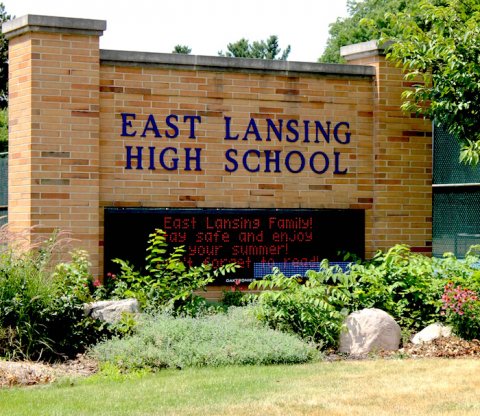
This was not a section that was altered as part of the effort to bring the code into compliance with the Supreme Court ruling, but rather a previously existing condition that was carried forward with the updates.
Council Member Ruth Beier commented that the East Lansing Hannah Community Center has an electronic sign that changes every few seconds. Council Member Shanna Draheim pointed out that the sign at the East Lansing High School changes much more frequently than once per day.
Yeadon explained that City-owned signs are exempt from the ordinance. During the May 15 discussion meeting, he described it this way: “Because we write the law, we get to break it.”
Meadows said that he was not comfortable with City-owned signs being in violation of the law, even if they were technically allowed to be. Beier commented that the problem seemed to be that there were many signs in town violating the once-per-day specification, but that the rule wasn’t being enforced.
In an effort to find a middle-ground, Meadows suggested an alternate definition of electronic sign from the municipal code of Charlotte, North Carolina, which he thought put more reasonable restrictions on electronic signs. He proposed using the Charlotte language in East Lansing’s code instead of the existing definition, but he was voted down by his colleagues who said more discussion on that particular issue was warranted before making such a major change.
Council Member Erik Altmann said that changeable electronic signs were a “distraction” and that he’d like to see them banned altogether. Beier also said that she found them “obnoxious” and that they did not fit “the character” of East Lansing.
Nevertheless, both Altmann and Beier voted to accept the new signage code, with the expectation of revisiting the specific designations regarding electronic signs in the near future.
Meadows' “nay” vote reflected his disagreement with the section of the code specific to electronic signs.
eastlansinginfo.org © 2013-2020 East Lansing Info