
You are on eastlansinginfo.org, ELi's old domain, which is now an archive of news (as of early April, 2020). If you are looking for the latest news, go to eastlansinginfo.news and update your bookmarks accordingly!
You are on eastlansinginfo.org, ELi's old domain, which is now an archive of news (as of early April, 2020). If you are looking for the latest news, go to eastlansinginfo.news and update your bookmarks accordingly!
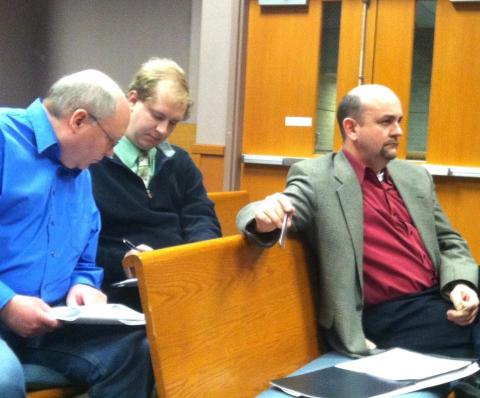
Image: PDIG's representatives listening to Council's deliberations last night
At last night’s work session, East Lansing’s City Council did not move forward to set a date to vote on the site plan and Special Use Permit from the Park District Investment Group (PDIG) for an eight-story building at Grand River Avenue and Abbot Road. Although it had been approved by Planning Commission, the developer’s site plan was still incomplete as of last night, and Council members’ concerns had yet to be addressed. Council also discussed significant concerns they had about the draft of a 28-page development agreement between the City and PDIG.
Council scheduled another review of the site plan at its next work session, on March 10, and the developer was asked to provide (1) a color rendering of the exterior of the building, showing building materials; (2) a revised drawing of the elevations of the building with legible labels of materials to be used; and (3) a plan for the outdoor open space on the second floor.
Mayor Pro Tem Diane Goddeeris had expressed concern at a previous meeting about open outdoor spaces on the second floor, asking how they would be subdivided to avoid the area being used as open party space. When she said that she could not locate the doors leading to this outdoor space in the latest plans, Todd Arend of Bergmann Associates said that, in their haste to complete the revised drawings, they had not put in the doors to the balcony area and they had yet to find an ideal solution to dividing the outdoor spaces for each room. Councilmember Ruth Beier agreed with Goddeeris that it is unacceptable and unsafe for hotel guests to be able to walk along this outdoor area to look into the balcony doors of other guests’ rooms.
Goddeeris also asked what the developer would be allowed to do with the two floors currently designated for the hotel if the hotel were to pull out. While the draft development agreement states that tax reimbursements would be made only if the building was constructed and used as stated in the site plan, it did not explicitly address this question. Goddeeris described the hotel as a deal-breaker for this property because “it controls how that building is maintained and presented and the type of uses that go into it.”
The City planning staff also presented to the Council for the first time the draft development agreement and Tax Increment Financing (TIF) plan for the PDIG project, stating that this latest version of the development agreement was acceptable to the developer. East Lansing’s Director of Planning Tim Dempsey stated that the development agreement was originally drafted by the developer and that City economic development staff and City Attorney Tom Yeadon had reviewed it with the goal of assuring that, at any point, the City would be better off than it had been previously and that risks were being mitigated. (ELi has reported that the review and negotiations with the developer have been underway since at least December 2014.) Dempsey said that the current draft was acceptable to the developer.
Councilmembers focused on two main issues of concern in this 28-page document.
One was the reliance on performance bonds to protect the city if the developer fails to complete either the public infrastructure improvements or demolition phases of the project. Councilmembers Beier and Kathleen Boyle both ask for more information about real-world experience as to whether insurance companies that issue performance bonds actually pay the full amount of the bond. Beier also asked for an assessment of whether putting money into an escrow account would be more secure than relying on performance bonds.
Citizen and former Council member Ralph Monsma also had raised multiple questions about performance bonds in his written communication to Council, saying, “The picture community members are getting on performance bonds is mixed at best. The dollar amounts to obtain them, the enforcement mechanisms to enforce them, and the legal limbo that can emerge in disputing them are of major concern.”
The second issue raised by several members of Council about the development agreement was the apparent insistence of the developer on a provision stating that it can assign the development agreement to another entity without approval of the City Council. Indeed, the agreement states that the “[d]eveloper contemplates the assignment of this Agreement together with all ancillary agreements in order to facilitate the financing necessary to construct the public infrastructure improvements and the Development Project and facilitate the joint venture necessary for the construction of various portions of the project including the hotel.”
City Attorney Yeadon told the Council that it was his position that assignment to another entity should require approval by Council, as had been stated in the January 22 version of the agreement. He said the developer said that they cannot get financing without the agreement being assignable without Council review, and added, “I don’t know whether that is the case of not.” Yeadon concluded that he would let the Council decide this issue.
Mayor Nathan Triplett and Councilmember Beier expressed strong preference for requiring Council approval of assignment to a new entity. Beier said the Council should exercise the same financial review and due diligence of a new partner as of the original applicant. Mayor Triplett expressed particular concern about the interaction between these two issues, i.e., the potential for a gap in coverage for the City at such time as the project is assigned to a new entity and that new entity is procuring a new performance bond.
City planning staff member Lori Mullins briefly introduced the draft TIF plan for PDIG’s projects, describing the $24.5 million in eligible expenses requested by PDIG. Beier stated that she intended to offer an amendment to the plan to delete the more than $9 million for construction of underground private parking. Beier says she does not believe private parking provides a public good, as TIF is designed to support.
Dempsey said the review of the development agreement might take two or three weeks. It is on the agenda of the Downtown Development Authority (DDA) on February 26, when the DDA also will consider legal and financial experts to hire as consultants to review documents on the PDIG project. Dempsey said that the legal review of the development agreement should happen before the City pays for a consultant to conduct the financial review, which could take 30-45 days.
This is a reversal of the order laid out in a flowchart that City Planning staff had provided to Council in January that they said would be used to ensure maximum protection of the City’s interests. The flowchart called for completion of consultation with external financial, real estate, and legal experts before consideration of the TIF and development agreement.
However, the Council and DDA have yet to discuss what a financial review and due diligence should include. In his public comment, Ralph Monsma stressed the importance of this issue, saying, “Who is PDIG? Who are the applicants? That question got more murky with change in the hotel situation. If you don’t know who you are dealing with, it is very difficult to figure out if they can deliver.”
eastlansinginfo.org © 2013-2020 East Lansing Info