
You are on eastlansinginfo.org, ELi's old domain, which is now an archive of news (as of early April, 2020). If you are looking for the latest news, go to eastlansinginfo.news and update your bookmarks accordingly!
You are on eastlansinginfo.org, ELi's old domain, which is now an archive of news (as of early April, 2020). If you are looking for the latest news, go to eastlansinginfo.news and update your bookmarks accordingly!
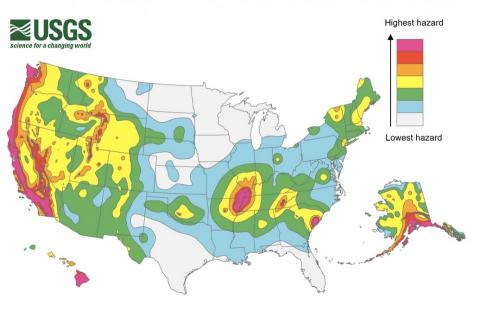
Image: Earthquake hazard map from the U.S. Geological Survey, showing a low hazard risk for the East Lansing area
A 4.2 magnitude earthquake centered five miles south and 3.7 miles below Galesburg, Michigan, shook East Lansing residents at 12:23:07 in the afternoon of Saturday, May 2, 2015. Houses rattled and neighbors came out onto porches to compare notes, while Twitter accounts reported people feeling the tremor in northern Indiana, South Haven, Grand Rapids, and Flint. This relatively small earthquake’s energy was 2.13x10¹⁵ Newton-meters, which is the equivalent of about three of the atomic bombs dropped on Hiroshima. There were no confirmed reports of injuries or damage in East Lansing.
As East Lansing residents are aware, palpable earthquakes are rare in the Red Cedar Valley and earthquakes originating in Michigan are even rarer. Indeed, the largest earthquake recorded in Michigan was a 4.6 magnitude 1947 quake centered very near epicenter of this week’s tremor.
There is written evidence of nineteenth-century earthquakes in the area that rattled windows and scared horses. The largest earthquakes east of the Rocky Mountains were the New Madrid, Missouri, quakes of 1811 and 1812, which were felt in Detroit. Earthquakes centered in the St. Lawrence River Basin in Quebec have also been felt in Michigan.
Because of the rocks and soils of the midwest, earthquakes in this area are felt and do damage over a wider area than those of the North American west coast.
Across the globe, the most common earthquakes arise from huge chunks of the earth’s crust moving against each other. These pieces of the earth’s crust, called tectonic plates, tend to converge at the edges of continents, like the San Andreas fault in California formed by the collision of the Pacific plate and the North American plate.
East Lansing is right in the middle of the North American plate, and consequently earthquakes here are not directly due to the convergence of tectonic plates. Instead, Michigan earthquakes are thought to be the result of internal stresses in the North American plate. The internal stresses of the plate build up and are believed to be released through an earthquake at the site of ancient faults left over from more active geological eras.
The sources of geologic stresses that lead to earthquakes in places like East Lansing are not always clear. There is concern about some human activities increasing the frequency of earthquakes.
Interestingly, tidal forces on land can likely trigger shallow earthquakes, like Saturday’s quake, at already stressed points in the crust. (We don’t usually think of “land tides,” but the moon’s gravitational pull on the land creates land tides just like it creates tides in the ocean waters.) Saturday’s noontime quake was at the high-tide point for May 2nd and very near the full moon of May 3, 2015.
It is also known that stresses from colliding plates can be transmitted inland as with the Northridge, California earthquake in 1994.
Another theory explains the geologic stresses in our area as originating in the earth’s slow uplift after the glaciers melted about 20,000 year ago. The weight of the glaciers pushed the molten and semi-molten mantel underlying the bedrock of the earth’s crust out from under Michigan and away to the south. Since the glaciers melted, the displaced mantel has been slowly flowing back north under the bedrock and pushing Hudson’s Bay up about 1 centimeter (just under half an inch) each year. While the crust in north rises, the crust south of Michigan falls, and the dynamic between the two has been hypothesized to explain earthquakes from Illinois to Quebec and may also apply to Michigan.
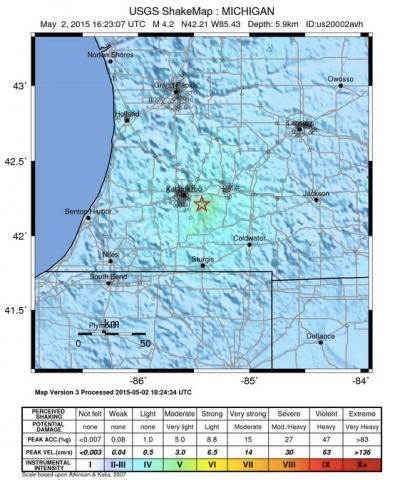
The image below, from the U.S. Geological Survey, shows the “shake map” for Saturday’s earthquake. You can participate in data collection by reporting your experience of the earthquake at the USGS’s website.
eastlansinginfo.org © 2013-2020 East Lansing Info