
You are on eastlansinginfo.org, ELi's old domain, which is now an archive of news (as of early April, 2020). If you are looking for the latest news, go to eastlansinginfo.news and update your bookmarks accordingly!
You are on eastlansinginfo.org, ELi's old domain, which is now an archive of news (as of early April, 2020). If you are looking for the latest news, go to eastlansinginfo.news and update your bookmarks accordingly!
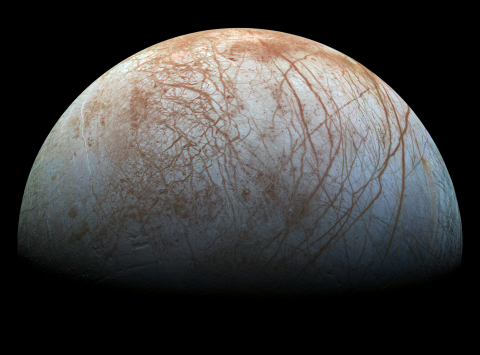
Image: “Europa’s stunning surface,” courtesy of NASA and the Galileo Mission
Winter weather has come to East Lansing, making for cold and potentially good conditions for astronomy. Because of how precipitation works, the coldest nights are often the clearest in East Lansing, and so can make for good, if brief, looks at the sky. (Tip: Observation sessions can be extended if, along with your binoculars, you pack a flask of something warming from Jonnna’s and some boot warmers from Moosejaw in downtown East Lansing.)
The earth’s moon was full last night, Sunday, January 4, and will rise later and later as the week goes on. The best star-gazing will therefore be of the brightest objects (like Jupiter). To view dimmer objects, you will need to be viewing just before the moon rises.
Jupiter will rise each evening this week and should be visible after 8 pm in East Lansing, weather permitting. Each evening Jupiter will rise in the east and make its way across the sky, setting in the west after sunrise. For a refresher about why Jupiter will be going “backwards” across our sky as the week goes on, take a look at EoE’s coverage of the retrograde motion of Jupiter from last month.
On a clear night, East Lansing residents with a pair of binoculars or a telescope should be able to see Jupiter and its four largest moons: Io, Europa, Ganymede, and Callisto. To see the moons, the telescope or binoculars really need to be on a tripod and have about 30x or better magnification.
Even though you need magnification to see them, know that these are big moons. They are actually the largest objects in the solar system after the sun and the eight planets, and are bigger than the planet formerly known as Pluto. (It’s still called “Pluto,” but it’s now officially a dwarf planet.) Ganymede is even larger than than the innermost planet of our solar system, Mercury.
These four moons were discovered by Galileo. As a group, these “Galilean moons” constituted the first demonstration that some celestial objects orbit something other than earth, and so the discovery of them helped support the Copernican theory of the solar system. Galileo wanted to name Jupiter’s moons after his patrons, the de’Medici family, but wiser heads prevailed, and the moons were named instead after the lovers of Jupiter and Zeus.
Each moon is interesting in its own way. Io has more active volcanoes than any other object in the solar system. Ganymede and Europa are thought to have layers of rock and ice, and Europa probably has subterranean oceans that might be amenable to life. Callisto has more surviving impact craters than any other known object in the solar system.
If you are interested in orbital mechanics, check out the 1:2:4 orbital resonance animation of Io, Europa, and Ganymede at Astronomy Now. If you’re out doing observations, keep in mind that these moons orbit Jupiter quickly—from every 3.5 to every 17 days—so the pattern of moons you see through your telescope or binoculars will change each night.
If you have a good enough telescope, the moons of Jupiter can function for you a bit like a clock in the sky. In fact Galileo suggested that observations of Jupiter’s moons could be predicted well enough and observed clearly enough that the Jupiter system could be used to tell time and calculate an observers longitude (how far the observer is east or west from a reference place like Greenwich, England.) It might have worked except that it was not a useful system during the day or on cloudy nights, and our system of longitude was worked out by a clockmaker.
ELi is a reader-supported, nonprofit, noncommercial news source for the people of East Lansing. So join your neighbors in contributing now to keep ELi going! Donate online or donate by check. Your contributions are tax deductible, and your contributions all go into the local economy by supporting our local writers, editors, and tech wizards.
eastlansinginfo.org © 2013-2020 East Lansing Info