
You are on eastlansinginfo.org, ELi's old domain, which is now an archive of news (as of early April, 2020). If you are looking for the latest news, go to eastlansinginfo.news and update your bookmarks accordingly!
You are on eastlansinginfo.org, ELi's old domain, which is now an archive of news (as of early April, 2020). If you are looking for the latest news, go to eastlansinginfo.news and update your bookmarks accordingly!
This promises to be an excellent year for the Perseid meteor showers in East Lansing. Sharp-eyed observers may see some early or late Perseids for a few weeks on either side of the shower’s peak, which is on the night-to-early morning of August 12-13. You can also read ELi’s coverage of the Geminids and the Lyrids.
This year has the potential for particularly good viewing of the Perseids because the moon will be waning to new, and so moonlight will not wash out the showers during the peak night. While all of the northern hemisphere will be able to see the Perseids, it turns out that this year earth will go through the densest band of meteors at 2-4 a.m. on August 13, giving East Lansing a chance to see the meteors at their most spectacular.
To view the Perseids, East Lansing residents should sit back in a chair or lay on the ground facing the northeast, and hope for clear skies. The darker the sky, the more meteors a viewer will see. Each meteor is a small piece of dust, rock, or ice left behind by the comet Swift-Tuttle from its 133-year orbit of the sun.
The best viewing of any meteor shower is in the last dark hours of the morning because the earth (and the observer) is rotating to face forward in the earth’s orbit. Imagine riding on a merry-go-round that itself is on the front of a train going down a track heading into a cloud of locusts. You will see (and feel) the most locusts when the merry-go-round rotates to face the front of the train.
In this example, the earth is a merry-go-round riding the train in its orbit of the sun into the cloud of dust and ice (locusts), and early morning is when East Lansing rotates to face into the path of earth’s orbit and the detritus that leads to meteor showers.
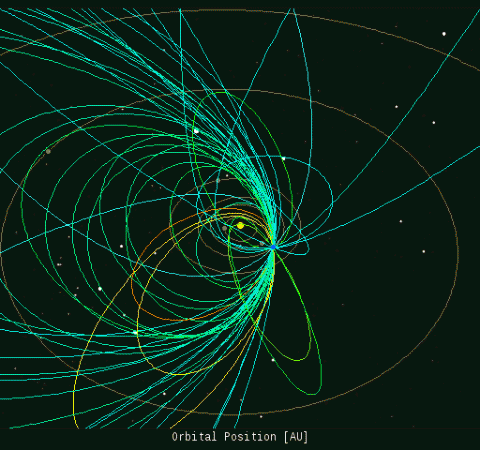
This year, experts expect (or hope) there will be about 100 meteors per hour, and there have already been fireballs from the Perseids tracked by NASA. Each night, NASA cameras track fireballs (meteors brighter than the planet Venus) and use their path across the sky to plot the original orbit of the material around the sun. (See above for a picture of the NASA-plotted fireball orbits from the night of August 9, 2015. The sun is the yellow spot in the middle of the picture, and all of the orbits intersect at earth.)
UPDATE, August 11, 7:30 am: People have been asking where I will be going to see the Perseids. My goal is to look northeast without the lights of Haslett being in my way. So I drive north on Abbot Road until it becomes Chandler Road, and continue north on Chandler. I pull off on a dirt road a couple of miles north, park safely, and enjoy the relative darkness.
eastlansinginfo.org © 2013-2020 East Lansing Info