
You are on eastlansinginfo.org, ELi's old domain, which is now an archive of news (as of early April, 2020). If you are looking for the latest news, go to eastlansinginfo.news and update your bookmarks accordingly!
You are on eastlansinginfo.org, ELi's old domain, which is now an archive of news (as of early April, 2020). If you are looking for the latest news, go to eastlansinginfo.news and update your bookmarks accordingly!
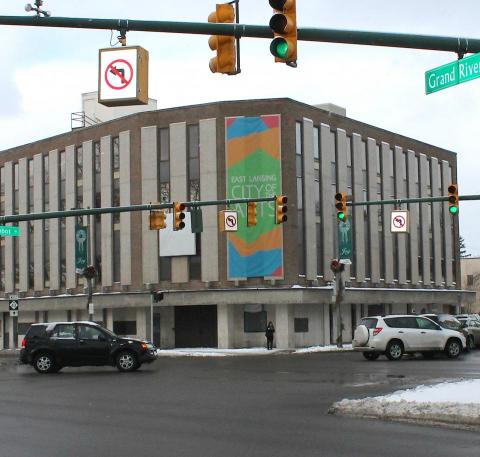
Image: The downtown corner where PDIG has proposed to construct "Builiding A"
Two days after East Lansing’s City Council voted 4-1 to approve the site plans for the developer PDIG’s two proposed buildings at the corner of Abbot Road and Grand River Avenue and next to Valley Court Park, at its monthly meeting East Lansing’s Downtown Development Authority (DDA) declined PDIG’s request for contingent approval of the development agreement and tax incentive package. Thursday’s DDA meeting suggested that, while PDIG wants the process hastened, there is still much to be learned and worked out on this project in the eyes of the DDA, including Mayor Nathan Triplett.
PDIG’s representatives have been clear they want to complete the next phase in the approval-and-agreement process as quickly as possible, and, as this Thursday’s DDA meeting approached, the staff of the City Planning department seemed to be seeking to accommodate PDIG’s wishes in that regard. An April 21 (Tuesday) memo from Lori Mullins, East Lansing Community and Economic Development Administrator, informed the DDA:
Staff understands that there is a need to have a contingent approval of the Development Agreement in order to allow PDIG to finalize the financing for the project. Once the financing is confirmed, then we will be able to have the remainder of the financial review completed by Mr. Leon at the National Development Council. A contingent approval could be a motion that would include language such as “Recommendation to approve the development agreement subject to an acceptable financial review by the DDA’s third-party consultant.”
But the DDA seems to be inclined to avoid contingent approvals, at least at this point. At its previous (March) meeting, the DDA had chosen two external consultants to review the legal and financing aspects of these agreements, which the flowchart for considering this project shows as the step after City Council’s site plan approval and before action on the development agreement.
The report from the legal consultant, the law firm Clark Hill, was distributed to DDA members within the 24 hours prior to their meeting. The scope of services of Clark Hill’s contract with the City includes a “legal entity review” in order to identify potential risk exposure to the City. Clark Hill’s four-page report did contain a cursory review of the legal entities involved in the Park District Investment Group, LLC. It includes previously-reported information about Scott Chappelle, the founder of Strathmore Development Company and the investment manager of Crouch Investment Group, which is the majority owner of Park District Investment Group (PDIG).
Clark Hill’s report states that “Strathmore and/or its affiliates have been involved in a number of unsuccessful or delayed development projects across the state” as well as project litigations in other states. It also notes that “the City and/or the DDA's financial consultant should be made aware” that the IRS “has initiated the collection of sizeable tax liens against Strathmore and its affiliates.” The Clark Hill report contained no new information about PDIG’s partners in this project.
In conjunction with Thursday’s meeting, PDIG provided to the DDA a letter from the Intercontinental Hotels Group (IHG) stating that “a license agreement is currently in effect for a Hotel Indigo to be constructed and operated in Building A of the proposed Park District Project.” However, this is not the same as a letter from the Chicago-based firm that has been granted the license from IHG to operate a Hotel Indigo at this site, a letter which PDIG promised the Planning Commission a few months ago. The fact that this hotel-franchise partner has yet even been identified suggests that the job of the legal consultant to vet the partners to this project is not yet finished.
It appears city staff have not acted on former Councilmember Ralph Monsma’s suggestion made during Public Comments at the February DDA meeting that the City ask PDIG to submit completed Michigan Department of Economic Development’s (MEDC’s) Key Personnel Certification Forms for all partners to this project. This would be one way to identify partners that the legal consultant should review.
The Clark Hill report contained eight suggestions for improving the February 18 draft of the development agreement so as to “further reduce risk and avoid changes to the scope of the project during construction.” On the morning of their meeting, DDA members received a new revision of the development agreement with revisions by the developer following its receipt of the Clark Hill report. Neither city staff nor the City Attorney had had time to review PDIG’s changes to the development agreement. Four DDA members expressed concerns about being asked to give any type of approval to the development agreement so quickly.
Nathan Triplett, who is a member of the DDA by virtue of being mayor, conveyed at the meeting that City Council would not be inclined to take any kind of action on the development agreement at present, when the process for obtaining financial information for review by consultants is still “half-baked.” Triplett offered a motion, agreed to unanimously by those present, that the DDA defer further consideration of the development agreement until its May meeting and direct staff to prepare a process for disclosure of entities associated with the development, as recommended by the Clark Hill report.
Even after the DDA deferred action on the development agreement, PDIG's representatives requested contingent approval of the Brownfield tax increment financing (TIF) agreement at the meeting of the Brownfield Redevelopment Authority (BRA) that immediately followed the DDA meeting. (Membership of the DDA and the BRA is the same.) Again, Triplett argued against contingent approval, saying that the Council would not approve a TIF plan separately from the development agreement and that it will also need to have the due diligence (i.e., legal and financial review) completed. The BRA agreed unanimously to defer action on the TIF plan to its next meeting.
PDIG had revised the TIF plan that it presented to the BRA for this meeting. (Tax increment financing, or TIF, allows a developer to be reimbursed for expenses from property taxes that ultimately result from a project. It is a form of public tax subsidy.) This latest version of the TIF plan excluded the underground parking in Building A (the eight-story building at the corner of Grand River Avenue and Abbot Road) from the eligible expenses of the TIF. This represents a reduction of $9,269,259.
Overall, the Eligible Activities Costs in the latest TIF plan total $17,354,454 instead of the $24,900,033 in the February 18 version. If the City Council were to approve the TIF plan, proposed for 25 years, all the added property tax resulting from the planned development would be used to reimburse the developer for various costs specified in the plan; the City would not receive any addition property tax revenue from these two buildings during this 25-year period.
DISCLOSURE: The author made a case at the DDA’s February 2015 meeting that the underground parking should be dropped from the TIF plan because the way the expensive valet-only, car-elevator parking system will operate would likely increase, rather than decrease, pressure on the public downtown parking system.
eastlansinginfo.org © 2013-2020 East Lansing Info