
You are on eastlansinginfo.org, ELi's old domain, which is now an archive of news (as of early April, 2020). If you are looking for the latest news, go to eastlansinginfo.news and update your bookmarks accordingly!
You are on eastlansinginfo.org, ELi's old domain, which is now an archive of news (as of early April, 2020). If you are looking for the latest news, go to eastlansinginfo.news and update your bookmarks accordingly!
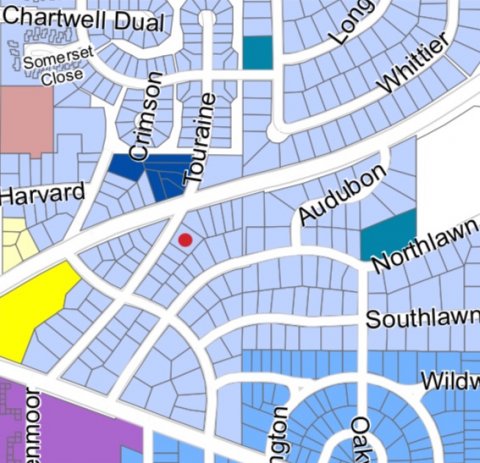
Above: In a map supplied by the City Planning Department, the red dot marks the lot in question.
A divided East Lansing City Council responded to a divided neighborhood last week, as four members of Council had to decide on a request to split the residential lot at 846 Touraine Avenue, in the northwest part of the Glencairn neighborhood. The lot split had caused concern among neighbors, some of whom have been vocal in their opposition.
“As far as I’m concerned there is no absolute property right”: that was the message that Mayor Pro Tem Erik Altmann delivered to explain his vote against the split. The results of the meeting seemed to reinforce that statement, with Altmann and Mayor Mark Meadows denying the request to divide the lot.
The lot split request began when the homeowner of 846 Touraine Avenue, Jeremy Nordquist, was approached by a single man, Antonio Mastromonaco, who expressed interest in building a new single-family home for himself in the neighborhood.
Nordquist and Mastromonaco decided that it would mutually beneficial to split the lot at 846 Touraine Avenue in order to create a new lot for Mastromonaco to build a home. Originally, 846 Touraine Avenue (bordered in yellow below) was platted as two separate lots, but they were combined some years ago, before digital records were kept.
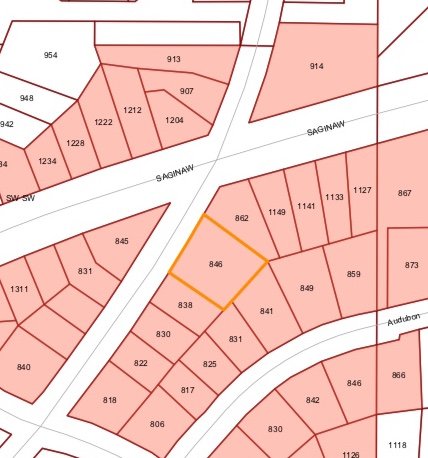
Once Nordquist and Mastromonaco began the process of asking for the lot split, some surrounding homeowners began to voice opposition to the plan in writing and in person.
At last Tuesday’s Council meeting, two residents spoke strongly in opposition to the split. These were Bill Rittenberg of 838 Touraine Avenue, and Jeanne Meier of 822 Touraine Avenue.
The opposition had two basic themes. First, some neighbors were worried that the new home will not fit the current aesthetics of the neighborhood, which is filled with homes built before World War 2. Second, neighbors were concerned that the lot split would eliminate open green space in the neighborhood.
So, their concerns centered on the feel and look of the neighborhood.
Below: A photo of the house at 846 Touraine (right), with the section of property to the left that could be split off for construction of a new house.
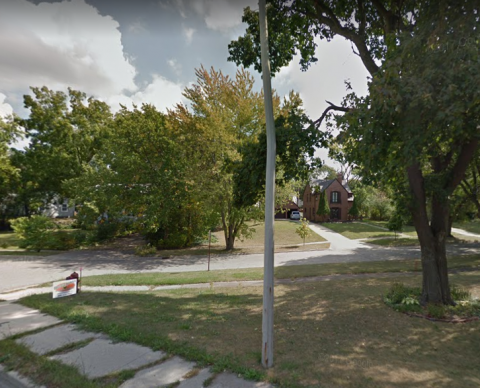
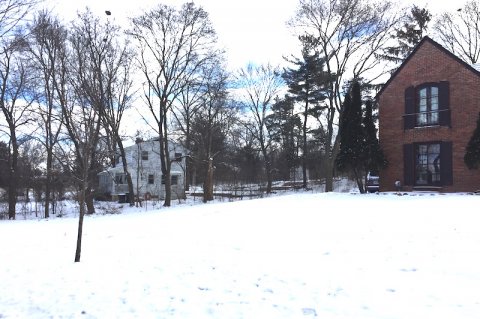
Below: A photo of 846 Touraine, taken this weekend. The land that would be split off is between the brick house at 846 Touraine and the white house seen in the distance on the left.
Below: Aeriel view of the location, supplied by the City.
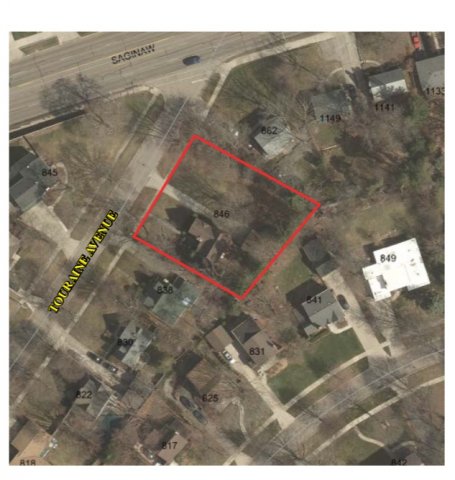
Before coming to City Council for a decision, the proposed lot split was taken up at the December 12, 2018, Planning Commission meeting. The eight members of the Commission present voted unanimously to recommend that the City Council approve the application.
Also in December, East Lansing’s Zoning Board of Appeals (ZBA) voted on the matter, approving a variance from the minimum lot area requirement. One of the new lots created by the split would be 7,793 square feet in an area that requires 8,000 square feet.
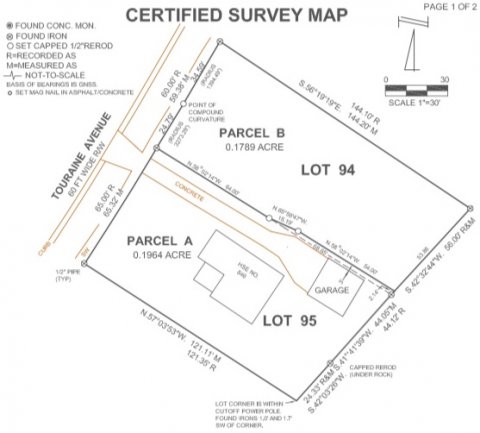
The lots would also have been narrower than the current standard requires, which is also true for many of the existing lots on the street, including the lots of some of the homeowners opposing the split. Existing setback requirements also created a need for a jog in the parcel split line, as shown by this survey of the proposed split:
The decisions by Planning Commission and the ZBA brought the project to Council for a final decision.
With Councilmember Ruth Beier absent because she is in California for the birth of her grandchild, only four members of Council were present: Altmann, Meadows, Shanna Draheim, and Aaron Stephens.
The vote came down 2-2, with Stephens and Draheim voting to approve, and Altmann and Meadows voting against. A split decision meant that the motion to approve the lot split failed, because approval requires a majority vote.
During the pre-vote discussion, Stephens indicated that, prior to the meeting, he took a drive down Touraine Avenue to scope out the lot and the feel of the area. His position was that the lot split and the addition of another single-family home would fit into the current look and feel of the neighborhood.
In discussing the issue, Draheim said she believes that decisions made by the Council should be made based on existing ordinances and not on individual complaints or concerns from community members.
But Altmann made clear he was against the split. “We tell people all the time what they can and can’t do with their property,” he said, disagreeing with Draheim’s point. He also noted that the split required a variance because it didn’t fit current standards for lot sizes.
“We have an enormous policy commitment [to] preserving neighborhood character,” Altmann said, expressing sympathy for those who said a new house could be out of place. He said that people who buy into a neighborhood have “baked-in expectations” that the character will remain the same.
That left Mayor Mark Meadows as the deciding vote. He told the applicant that he wasn't generally opposed to the idea, and that he thought the homeowner had the right to do it.
Meadows stated, however, that without specific elevations and renderings of the house that would be constructed, he couldn't vote in the affirmative. He explained that, although Mastromonaco could promise, as he was doing, to build a house that fits the neighborhood, after the lot split was approved, Council would have no power to enforce that. (Proposals for single family houses do not require Planning Commission review or Council approval.)
The Council gave Mastromonaco the option to defer the motion, a technical move that would push the decision to a February Council meeting, in order to show Council professional designs of what he wanted to build. Mastromonaco was not warned in advance that he might be asked for such drawings before a decision would be made, however, because they are not required as part of a lot split application.
Offered the deferral option, Mastromonaco indicated that the process had taken too long and that the professional plans Council was calling for would cost thousands of dollars more than already spent and Council might still say no. He said he wanted an up or down vote.
The 2-2 vote – a failed motion – means that, if Nordquist and Mastromonaco want the lot split, they will have to start the process over.
eastlansinginfo.org © 2013-2020 East Lansing Info