
You are on eastlansinginfo.org, ELi's old domain, which is now an archive of news (as of early April, 2020). If you are looking for the latest news, go to eastlansinginfo.news and update your bookmarks accordingly!
You are on eastlansinginfo.org, ELi's old domain, which is now an archive of news (as of early April, 2020). If you are looking for the latest news, go to eastlansinginfo.news and update your bookmarks accordingly!
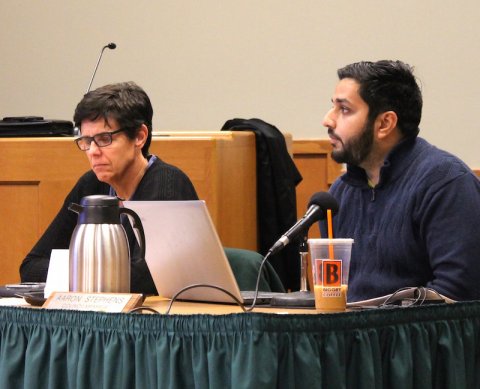
Above: City Council Members Ruth Beier and Aaron Stephens on October 16, 2018.
East Lansing’s City Council will hold a public hearing and possible vote tomorrow night on a major marijuana regulatory issue: where in East Lansing medical marijuana can be sold. This special meeting comes with little notice to the public on a matter that has previously drawn much public comment.
Council Member Aaron Stephens – who has been consistently pushing for greater transparency in East Lansing government – specifically asked City Manager George Lahanas at the October 16 Council meeting that all local media outlets be alerted about this recently-scheduled hearing and possible vote, in an effort to keep the public informed.
Stephens also asked that Lahanas include in a press release detailed information about the meeting as well as the draft legislation, including maps and graphics that might help the public understand and speak in an informed fashion on the issues being considered.
But Lahanas has not followed Stephens’ request.
East Lansing’s Council of Neighborhood Presidents has also not been informed of the meeting, as usually happens with Council meetings. Members of that group often alert their constituents about issues of major concern to neighborhoods.
At tomorrow’s meeting, set to start at 8:15 p.m. to accommodate Council Member Ruth Beier’s class schedule, the Council will consider Ordinance 1416a, a law that, if passed, will determine where, if anywhere, medical marijuana “provisioning centers” can be legally located in East Lansing.
ELi reported that in early September, Mayor Pro Tem Erik Altmann blocked attempts by Council Members Aaron Stephens and Shanna Draheim to schedule a public hearing on this draft ordinance.
Altmann said he did not think there was a point in having a public hearing if a draft ordinance was unlikely to pass, suggesting that, at that time, he did not see three votes in favor. Altmann effectively vetoed scheduling of the hearing.
In response to Altmann, Stephens objected to the idea of only scheduling public hearings if a vote in favor was a foregone conclusion, and Draheim warned that not passing local regulation soon could put East Lansing at risk of losing local control if the statewide vote on Proposition 1 to legalize recreational marijuana passes on November 6.
When Mayor Mark Meadows came back from his six-week vacation in Spain and ended his formal Council leave, he apparently agreed with the idea that East Lansing needed to act.
ELi reported that on the morning of Friday, October 12, Meadows, Altmann, and Beier met and voted in a virtually-unannounced, five-minute City Council meeting to schedule this public hearing.
Stephens skipped that surprise meeting, telling ELi, “I was stuck between a policy I wanted to move forward and a process I thought was not transparent.”
Draheim told ELi she had to miss the surprise meeting because she was in a day-long meeting on preemption – the legal term for when state actions overrule local control, the very issue Draheim had warned Altmann back in September was a risk if Council didn’t move on medical marijuana regulation.
Stephens’ attempts to push for greater transparency have extended into various areas but have been stymied as Meadows, Altmann, and Beier have been largely voting (or not-acting) as a majority block against Stephens’ moves to provide more information and engagement opportunities to the public.
For example, back at the September 17 meeting, Stephens said he wanted to bring discussions with developers on major projects out into the open, holding them at discussion-only City Council meetings where the public could attend and watch.
But his request has not been moved forward, and as ELi reported, Meadows and Altmann have been meeting with “Park Place” developer Paul Vlahakis as terms for that deal are being put into a legal agreement before a site plan is ever made public.
After last week’s Council meeting officially ended, Meadows, Altmann, and Beier held what appeared to be a private conversation at City Hall for about 10 minutes. The Michigan Open Meetings Act indicates that a quorum – in this case, three City Council members – can meet and hold conversations outside regular meetings only in extraordinary circumstances involving non-policy discussions, like special award ceremonies.
The materials that have been made publicly available on Ordinance 1416a can be viewed at the posted agenda, here. Members of the public can comment on the ordinance or any other matter at the meeting and can also write to City Council via email at council@cityofeastlansing.com.
UPDATE: Want to know what happened? Here's our report.
eastlansinginfo.org © 2013-2020 East Lansing Info