
You are on eastlansinginfo.org, ELi's old domain, which is now an archive of news (as of early April, 2020). If you are looking for the latest news, go to eastlansinginfo.news and update your bookmarks accordingly!
You are on eastlansinginfo.org, ELi's old domain, which is now an archive of news (as of early April, 2020). If you are looking for the latest news, go to eastlansinginfo.news and update your bookmarks accordingly!
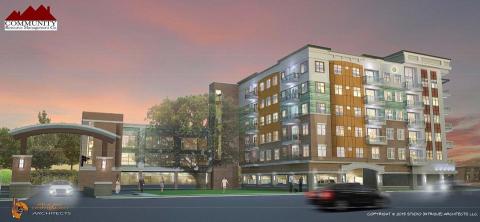
Above: Architect’s rendering of the proposed development.
East Lansing’s City Council is likely to vote tomorrow on an almost $6.4 million tax subsidy requested by a developer-landlord for construction of a new rental apartment building. With Mayor Mark Meadows and City Manager George Lahanas having already publicly voted against the plan in an earlier forum—and with the City’s government in the grips of trying to figure out how to manage what its finance director has called “staggering” debt—the plan’s chances of passing as proposed appear more uncertain than previous similar tax subsidies for developers.
The proposal at issue is a Tax Increment Financing (TIF) plan for a 231-bed, mixed-use, six-story building at the northwest corner of Grand River and Spartan Avenues, a quarter-mile west of Hagadorn Road. The planned development is called White Oak Place, a name referring to a large, old tree on Spartan Avenue that would be located in a courtyard bordered by a six-story structure with underground parking. The developer is a limited liability company represented by Joe Goodsir of Community Resource Management Company, a major landlord of student rentals in East Lansing.
According to Mayor Mark Meadows, the Council may take final action on both the site plan and TIF plan at tomorrow’s 7 p.m. meeting in City Hall.
TIF works by diverting new tax income to reimburse developers for approved expenses. It is aimed at promoting development on sites that are environmentally contaminated, functionally obsolete, or blighted. The vote on the requested White Oak Place TIF, valued at $6,376,000, will be significant in several ways.
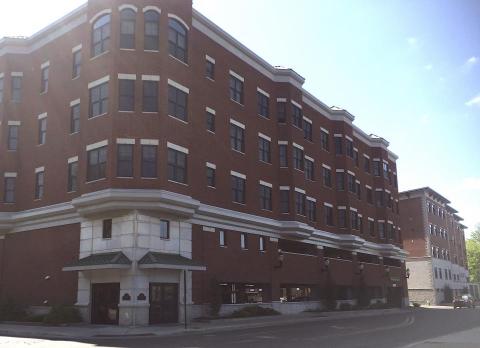
First, this TIF is much larger than all but one of the fifteen Brownfield Redevelopment Authority (BRA) TIFs that the East Lansing City Council has approved since 2005. For example, recent TIFs include $3.4 million for The Residences (the HopCat building) and $2.7 million for Trowbridge Plaza. The only comparably sized TIF was $6.7 million for Albert Place Condominiums (shown immediately below), completed in 2008, which added 36 condos to the downtown.
Second, this is the first TIF plan to be considered by the current City Council, in which Erik Altmann, Shanna Draheim, and Mark Meadows joined incumbents Ruth Beier and Susan Woods. (The three new members replaced Kathleen Boyle and Diane Goddeeris, who did not seek reelection, and then-mayor Nathan Triplett, who was defeated in the election.)
The City’s 2016-2017 budget shows that just over $1 million in property taxes that otherwise would be income to the City during its next fiscal year will instead be used to reimburse developers of the fifteen projects that have received BRA TIFs (with a small amount going to the City to administer this program).
If approved, the White Oak Place TIF would add $306,000 to $414,000 in taxes each year (over the estimated seventeen-year life of the TIF plan) to the sum of money being diverted to developers for reimbursement. If the project were built as planned with the TIF proposed, the City would get about $34,000 to $46,000 in additional taxes per year over the estimated-seventeen-year life of the plan, and after that would get its full share of the property taxes due.
The current City Council agreed unanimously to a resolution in February that identified “what, if any, standards … should apply to the grant[ing] of development incentives” as one of the topics for the City’s recently-convened Financial Health Review Team to address. By contrast, prior City Councils approved every TIF that developers requested, although sometimes in contentious split votes.
This TIF proposal is also significant in that it marks the first time that we know of that the City has paid an external consultant to review a TIF plan submitted on behalf of a developer. The independent consultant’s report, by ASTI Environmental of Brighton, Michigan, was made available to member of Council and the public on Friday.
East Lansing’s Brownfield Redevelopment Authority, which reviews plans before they come to City Council, recommended the $6.4 million TIF plan to the Council in a split vote. On February 25, seven members of the Brownfield Redevelopment Authority voted in favor and three voted against; notably, Mayor Meadows and City Manager Lahanas were two of the votes against.
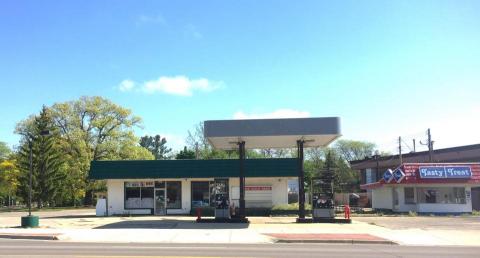
Several specific controversies about this TIF proposal have arisen, in addition to concern about its dollar size. Mayor Pro Tem Ruth Beier has questioned whether saving the large, old tree is worth relinquishing potential tax income when they City has so many financial problems. The project was revised to have more floors (six instead of three or four) concentrated on a smaller footprint so as to not cut down the tree. (Whether the tree can realistically be kept alive through construction is a controversy surrounding the site plan itself. See below for the site as it currently exists; the large oak tree is in the background at left.)
The revised site plan added underground parking rather than less expensive surface parking. Not only is underground parking much more expensive to build, it also would entail significantly higher environmental remediation costs at this site. As ASTI Environmental’s report noted, “a significant amount of the environmental activity costs are [sic] due to the depth of excavation required for the construction of the proposed underground parking structure.”
A related question about this TIF is whether it should include any expenses other than those required directly for environmental remediation—even if they are legally allowable expenses under Michigan law. Councilmember Erik Altmann has asked for the cost of environmental remediation, particularly the contaminated site of a former gas station, that would be needed to essentially change this “brownfield” to a “greenfield.”
More than a quarter of the TIF plan—$1.8 million of the $6.4 million total—is set to cover interest payments to reimburse the developer for the cost of borrowing money for this project. This is legally permissible but controversial.
City Council’s published agenda has this issue set to come last in its meeting tomorrow night. Technically the public hearings on this matter have already been held, although the revised site plan and TIF plan were not yet available. (Council had advertised that there would be a public hearing, so it was held in the absence of updated information.)
Members of the public can speak tomorrow during the section dedicated to “communications from the audience” near the start of the meeting and can also write to Council if they wish to comment on this or any other issue before the City.
eastlansinginfo.org © 2013-2020 East Lansing Info