
You are on eastlansinginfo.org, ELi's old domain, which is now an archive of news (as of early April, 2020). If you are looking for the latest news, go to eastlansinginfo.news and update your bookmarks accordingly!
You are on eastlansinginfo.org, ELi's old domain, which is now an archive of news (as of early April, 2020). If you are looking for the latest news, go to eastlansinginfo.news and update your bookmarks accordingly!
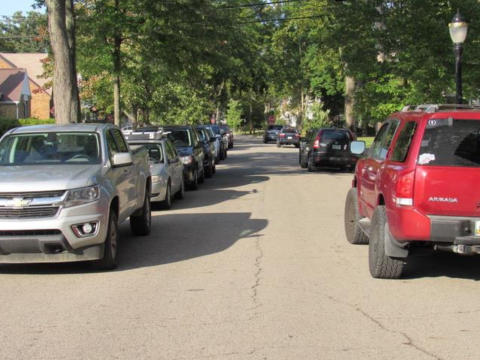
Above: An image from House’s presentation, showing Butterfield Drive in 2017 on a game day.
East Lansing’s City Council Members heard recommendations from Public Works Director Scott House about a possible new standard for on-street parking in East Lansing at their meeting this Tuesday. The top concern is safety – whether emergency trucks can get down heavily-parked streets, particularly during game days, and whether over-parking leads to hazards for pedestrians and drivers alike.
Council Members’ remarks suggested they are favorable to moving ahead with a more consistent plan for on-street parking. This will mean, for example, using street widths to determine which streets shift to no-parking and to single-side parking.
House had presented the Council with a map of East Lansing streets with a color coded key indicating street widths last March. Since that time, the Fire Department and Parking and Code Enforcement (PACE) have weighed in on the problem, and the Transportation Commission has offered up recommendations for a consistent parking code throughout the City.
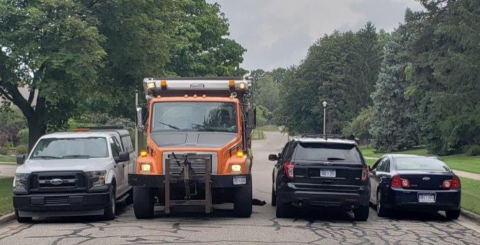
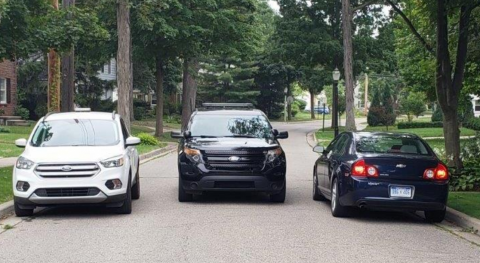
For streets with a width of less than 24 feet, the recommendation would be no parking on either side of the street. Streets with a width of 24 feet to 31 feet would have single-side parking, and there would be two-sided parking allowed on streets of 32 feet and wider.
Below: Applegate Lane at Cranston Court (about 32-feet-wide), from House’s presentation
For streets restricted to one-sided parking, the side with the least obstacles – such as fire hydrants and driveway cuts – would be used for parking, so that the number of legal parking spaces could be maximized.
Current East Lansing building codes require streets to be at least 28 feet in width, with a narrower 24-foot option on private roads, such as in the Hawk Nest subdivision. According to House, following the recommendations from the Transportation Commission (which he referred to as reasonable) would make over half of the roads in East Lansing “one side only” parking, and eliminate approximately 2,300 parking spaces if applied city-wide. (Click here to see the map showing road widths.)
House explained that the eliminated parking places aren’t necessarily places that people are regularly using.
“There are a whole host of areas that aren’t signed ‘no parking’ that people don’t typically park, but this would [formally] rule them out,” he told Council on Tuesday. “And there are some areas as you enter into neighborhoods, very narrow, twenty-foot-wide, you wouldn’t think someone would park there, but on game day they might.”
He also discussed neighborhoods such as Lantern Hill, where there are no curbs but rather streets that abut yards, ditches, or flower beds, which might be disturbed by parked cars. He referred to the Red Cedar neighborhood as “the biggest challenge” since “there’s a lot of off-street parking there, where people will use front yards, the graveled area, for parking or storage. This would take away a lot of parking from there as well.”
Over the last two years, there have been numerous City Council meetings focused on residential parking in the Chesterfield Hills neighborhood. Citizen comment at those meetings has repeatedly brought up the problem of emergency vehicle access on narrow roads where parking is allowed on both sides.
Below: Butterfield Drive near Collingwood, about 24-feet-wide.
Some areas of Chesterfield Hills now require residential permits to park on the street at all, and residents unhappy with that policy have circulated petitions to eliminate that requirement on individual streets, or move to a two-hour time limit. In the face of much strife over parking in that neighborhood, various Council members have suggested that a consistent parking policy, at least for that neighborhood, could be the solution.
On Tuesday night, Council Members disagreed on how the Transportation Commission’s recommendations should be applied, if they are to be adopted. Should they be implemented city-wide, or only in “core” neighborhoods near MSU, where parking is denser? If the recommendations are adopted city-wide, should they be done all at once or rolled out from the campus-adjacent areas into other neighborhoods as staff time commitments allow?
House explained that developing the plan and then installing the signs would be a labor-intensive process that could take DPW employees away from other important responsibilities.
Mayor Pro Tem Erik Altman, who presided over the meeting due to Mayor Mark Meadow's vacation, said that an advantage of a neighborhood-by-neighborhood approach was that it allowed City staff to see where displaced cars would go.
“Cars are like water, right, they flow in unpredictable ways,” Altmann said. He also complimented City staff on the “enormous amount of work” that staff had put in compiling the data for the plan.
Council Member Shanna Draheim said that there might be some initial shocked reactions, but that in the conversations that she had had with East Lansing citizens, she thought a lot of people would be “grateful” for the increased safety provided by the plan.
Draheim and Altman disagreed on the best course forward. Draheim said that she felt it was important to fix the existing residential parking permit program (RPP) before moving forward with a sweeping change. Altman said he thought the RPP program and the safety concerns being addressed in the presentation were two separate issues.
According to House, a multi-year or neighborhood-by-neighborhood approach to implementing a new policy could be accomplished by City staff, but doing it in a shorter timespan would require hiring contractors.
“Simplifying our parking system is definitely something that we should be doing, and I think this is a pretty incredible step in the right direction,” said Council Member Aaron Stephens.
[Correction: when this story was publishedm we incorrectly identified Butterfield as being in Chesterfield Hills. It has been corrected, and ELi thanks the reader who alerted us to our error.]
eastlansinginfo.org © 2013-2020 East Lansing Info