
You are on eastlansinginfo.org, ELi's old domain, which is now an archive of news (as of early April, 2020). If you are looking for the latest news, go to eastlansinginfo.news and update your bookmarks accordingly!
You are on eastlansinginfo.org, ELi's old domain, which is now an archive of news (as of early April, 2020). If you are looking for the latest news, go to eastlansinginfo.news and update your bookmarks accordingly!
Here at Eli, we are citizen journalists.
Both Publisher Alice Dreger and I are professional writers, and both of us have extensive experience with collecting, analyzing and breaking down large and complicated amounts of information for the purpose of communicating that data in ways that are clear, honest and useful. Our training has been different from formally schooled journalists—my degree is in law (J.D.), and Alice’s is in history of science (Ph.D.)—but our skill set and experience are a good match for the work of fair and ethical reporting on the community.
Jay Rosen, a journalism professor at New York University, says that citizen journalism is “[w]hen the people formerly known as the audience employ the press tools they have in their possession to inform one another.”
Many have welcomed this new age in news coverage, saying that citizen journalists have a unique opportunity to take a fresher and faster look at what’s happening anywhere, anytime, using embedded reporters and digital technology. From the Arab Spring in Egypt to the post-verdict riots in Ferguson, MO, the truest and most unfiltered words and images came from those with boots on the ground who had access, intimacy and understanding.
Others have argued that without the ethical constraints and well-established practices connected to more traditional journalism, what results is a kind of Old West free-for-all in which bias goes unchecked, facts are unverified and sources are treated unfairly. How can an untrained observer who possibly has ties to participants in the story provide “unbiased” reporting? How can a reader trust that what is offered to them by citizen reporters was fact-checked and not merely a careless series of assumptions?
For the past week, Eli has had the opportunity to cover a big, complicated story and bring it to you first, as citizen journalists. From the moment we received a tip that there was a lawsuit pending against the City of East Lansing based on allegations that employees were inappropriately exposed to unsafe levels of mercury and asbestos, we understood that the story needed to be told, and that it had to be told completely fairly.
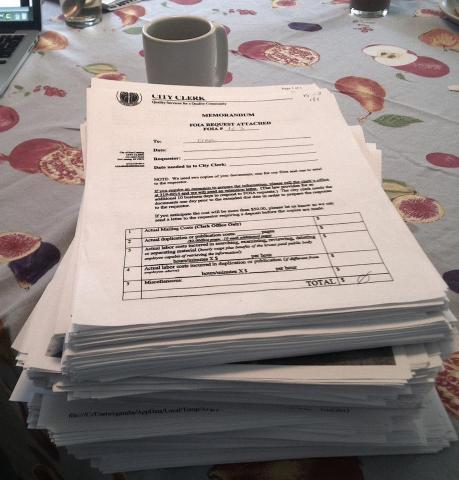
Alice Dreger obtained several inches worth of information using the Freedom of Information Act (see photo above), and spent literally days reading and organizing. (And, by the way, several inches of FOIA documents are not inexpensive. The stack cost ELi’s bank account $676.95, and we agonized for about a week before spending that much of the organization’s money on “buying” what amounted to a total unknown in terms of contents.) Alice turned this into a series of articles, first about the lawsuit (a piece I co-authored) and then about the mercury spill at the City’s Waste Water Treatment Plant. For each article, I provided a second pair of critical eyes before publication, nitpicking, challenging and double-checking.
Here’s what we hope all of our readers really understand: We strive to be unbiased, thorough and compliant with current ethical standards in journalism not because we are afraid of being sued or disliked; we are this careful because this is our community.
I am incredibly proud of what Alice has been producing, and I’m confident that what Eli has been delivering has been no no careless free-for-all, but the very best kind of citizen journalism. We are getting fan mail saying just that.
And if you know a story? Whether it’s beautiful or terrible, large or small, we hope you’ll leave the audience and join us in telling the stories of East Lansing.
eastlansinginfo.org © 2013-2020 East Lansing Info