
You are on eastlansinginfo.org, ELi's old domain, which is now an archive of news (as of early April, 2020). If you are looking for the latest news, go to eastlansinginfo.news and update your bookmarks accordingly!
You are on eastlansinginfo.org, ELi's old domain, which is now an archive of news (as of early April, 2020). If you are looking for the latest news, go to eastlansinginfo.news and update your bookmarks accordingly!
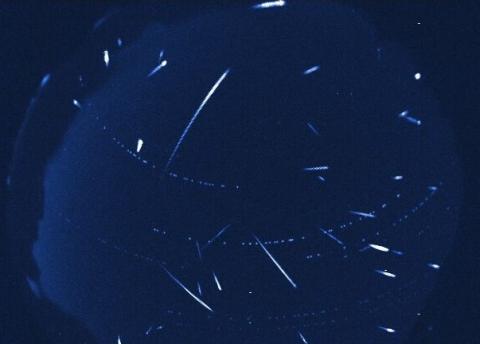
Image of the Lyrid meteors as captured by NASA
This week is the best time for viewing the Lyrid meteor showers in East Lansing. The early mornings of April 22 and 23 (Wednesday – Thursday) will be the best time for viewing. No one knows how frequent the meteors will be from year to year. For the last two years, the light of the moon has made viewing difficult, but this year the moon will not be up during the early morning hours of prime viewing so it should not interfere. If there are clear skies, East Lansing can hope for good meteor viewing.
The best time to view all meteor showers is in the early morning. As the earth rotates, the morning brings the observer to the front side of earth in its orbit around the sun. It is the front side of the earth that runs into the comet dust and debris that create meteors.
The debris that forms the Lyrid meteors themselves came from Comet Thatcher, which orbits the sun every 415 years and last passed through the inner solar system in 1861. As the earth moves through the comet’s orbital path, the flotsam and jetsam of the comet hit the earth’s atmosphere and it burns brightly in our sky. The earth is moving about 67,000 miles an hour relative to Comet Thatcher’s debris.
If you trace back the path of meteors you see during the Lyrid Meteor showers, the path of all those meteors will originate in the constellation Lyra and radiate out like spokes from the hub of a wheel. You can read about ELi’s coverage of the Geminids, which appear to come from the constellation Gemini.
The constellation Lyra will be in the northeast on the mornings of the best viewing. Constellations are groups of stars that are in the same place in our sky, but some may be very far away while others are much closer. The stars of a constellation may look spatially related to each other from a viewer in East Lansing, but most of the time the stars of a constellation are not neighbors in space. Astronomers use constellations to divide up the sky so people can find stars and planets relatively easily.
Within the boundaries of the constellation Lyra are some important deep space objects including the Ring Nebula, which can be seen with binoculars or a good camera. Lyra also contains harder-to-see stars and many planets, called exoplanets, around those stars. A couple of these exoplanets, Kepler 62e and 62f, which orbit their star (Kepler 62) are in the “habitable zone” and might be candidates for harboring earth-like life.
Vega is the brightest star in Lyra, and is only 25 light-years from earth. Vega is close enough to earth that astronomers can tell something about the dust and debris that surrounds the star. In 12,000 BCE, the axis around which the earth rotates pointed north to Vega making Vega the North Star then. The earth’s axis wobbles in a circle over 26,000 years, and right now Polaris is the earth’s North Star. In about 14,000 CE, Vega will again be the North Star for East Lansing astronomers.
eastlansinginfo.org © 2013-2020 East Lansing Info