
You are on eastlansinginfo.org, ELi's old domain, which is now an archive of news (as of early April, 2020). If you are looking for the latest news, go to eastlansinginfo.news and update your bookmarks accordingly!
You are on eastlansinginfo.org, ELi's old domain, which is now an archive of news (as of early April, 2020). If you are looking for the latest news, go to eastlansinginfo.news and update your bookmarks accordingly!
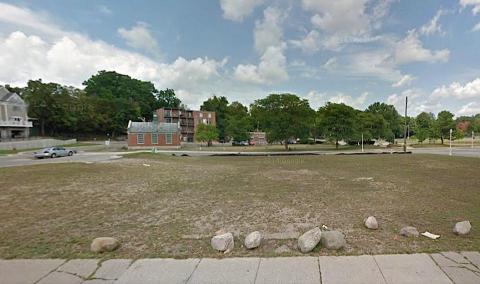
Image: The empty lot now at 300 West Grand River Avenue (courtesy of Google streetview)
At its work session this week, City Council continued review of DTN’s “Gateway Project,” proposed for 300 West Grand River Avenue, an empty lot just to the east of the West Village 2 townhouse condos. Council and City staff also debated whether the project warrants public subsidy in the form of tax increment financing (TIF).
DTN’s development proposal is for a four-story building with 39 two-bedroom rental apartments, a drive-through bank and other first-floor commercial space, and underground parking for residents. At the Council work session on Tuesday, DTN’s Colin Cronin reported to Council on the revised conceptual site plan it had developed following consultation with some owners of the West Village 2 condos. Mayor Pro Tem Diane Goodeeris had suggested this consultation at Council’s April 21 meeting because condo owners had raised objections to DTN’s proposal.
In the revised plan, the dumpster for the new property will be located on the 300 West Grand River Avenue property rather than on the West Village 2 property, although an easement would have allowed for the previous location. Also, the drive along the west side of the new project is now designed to be a one-way egress to West Grand River Avenue, and this drive is separated from the West Village parking lot so the two properties are completed separated from each other in terms of traffic flow.
Goddeeris and Councilmember Susan Woods expressed appreciation for the condo owners and developer working together to arrive at a solution.
Mayor Nathan Triplett asked for a final, modified site plan before the next Council meeting, and Cronin said DTN could provide it on this schedule. Cronin confirmed to Councilmember Ruth Beier that balconies on the west side of the building will be only “Juliette” balconies, which will be shown in the new plan. (The condo owners had asked to have no balconies facing their properties.)
At the work session, Council also considered “Brownfield Plan #4 for 300 West Grand River Avenue,” which is the proposed tax increment financing (TIF) plan for the new project site. Community and Economic Development Administrator Lori Mullins presented information about Phase III of the tax increment financing (TIF) plan that had been requested previously by Beier.
This latest amendment to the TIF plan would use monies captured as property taxes on the new development to reimburse the developer for costs primarily of building underground parking.at the new building. The previous two phases of this TIF plan were largely for infrastructure costs, which already have been expended and will be reimbursed under terms of the TIF plan that began nine years ago on the site of this project and the West Village 2 condos.
Beier suggested that the Council might treat the Gateway project as an “economics experiment” to test whether a TIF is really needed for a student housing development in the downtown. She said that the Council would certainly prefer to have developments built without subsidies if possible and noted that some other recent student housing projects did not request TIF. Beier was essentially suggesting that Council decline to provide additional TIF for this project and see whether it gets built.
According to Beier, there is little risk of attempting the “experiment” at this site because it is a grassy lot, not a blighted property. If the developer decided not to build without a TIF subsidy, some form of construction could happen there at a later time, perhaps when a parking structure had been built in the west end of downtown.
Beier questioned the idea of giving a public subsidy for a student housing that is already in ample supply rather than reserving TIF for other types of housing which the City needs in order to create a more diverse downtown. Said Beier, approving this TIF plan would be a purposeful decision by the City to “spend” about $40,000 per year for the next 21 years (i.e., forego property tax income at $40,000/year) for this kind of development.
Councilmember Kathy Boyle shared Beier’s concern about the Council granting a tax subsidy plan for a type of housing that already has a saturated market. According to Boyle, while student rentals would certainly be filled at this location right across from MSU, it will likely draw student tenants from other parts of the city which will have a negative impact on other student landlords; at some point this could lead to a diminishing returns in terms of property taxes paid to the city.
Boyle spoke in favor of building senior housing in close proximity to campus and said she would favor using tax financing tools to encourage such housing, which does not now exist.
City Manager George Lahanas and Planning Department head Tim Dempsey argued that the TIF package had been originally established at this site as part of a plan to encourage owner-occupied housing in West Village instead of high-rise student rentals that the developer originally proposed. However, the economic recession made expanding condominiums beyond the current West Village unviable.
Beier pointed out that, at this juncture, the TIF is being proposed for a new building of student rentals, not the owner-occupied units that were originally envisioned.
Triplett said that he agreed with much of what Councilmember Beier said, but pointed out that some of the student rentals recently built without TIF subsidies, such as along Michigan Avenue, used most of the ground level for parking, leaving little of the first floor for activities that would benefit downtown and attract pedestrians.
This lead to considerable discussion among Councilmembers and the City Manager about parking policy downtown and the possibility of moving toward more intensive development with lower parking requirements. Lahanas argued that this was the model in some other cities, such as Ann Arbor, but that East Lansing did not yet have sufficient density to make this work, for example, to have a downtown grocery store that would make living without a car easier.
When Beier raised the possibility of considering reducing the parking requirement for the Gateway project, Goddeeris responded that these parking issues are part of a Comprehensive Plan discussion and cannot be addressed for one particular project in a way that could be seen as unfair. Beier asked DTN to bring evidence that this development cannot go forward without the Brownfield tax plan.
A public hearing on the Gateway Brownfield plan is scheduled for Council’s meeting next Wednesday, May 6.
Reminder: Members of the public can comment at East Lansing City Council meetings on any issue, and can also communicate with Council in writing by emailing council@cityofeastlansing.com.
eastlansinginfo.org © 2013-2020 East Lansing Info