
You are on eastlansinginfo.org, ELi's old domain, which is now an archive of news (as of early April, 2020). If you are looking for the latest news, go to eastlansinginfo.news and update your bookmarks accordingly!
You are on eastlansinginfo.org, ELi's old domain, which is now an archive of news (as of early April, 2020). If you are looking for the latest news, go to eastlansinginfo.news and update your bookmarks accordingly!
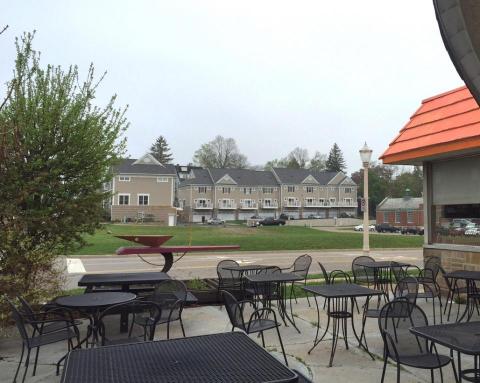
Image: The empty lot where the project is proposed, as seen from Biggby looking west toward the West Village condo townhouses.
Last night the East Lansing City Council unanimously supported a revised site plan for DTN’s proposed four-story building at 300 West Grand River Avenue and also voted 3-2 in favor of a Brownfield tax subsidy plan for the proposal. The site plan, approved 5-0 by Council, includes 39 two-bedroom rental apartments, a drive-through bank and one other commercial space on the first floor, and underground parking for residents. The vote on the almost $1.9 million Tax Increment Financing (TIF) plan was 3 to 2, with Mayor Nathan Triplett, Mayor Pro Tem Diane Goddeeris, and Councilmember Susan Woods voting in favor and Councilmembers Ruth Beier and Kathy Boyle voting against.
Arriving at the final shape of the site plan has been complicated because of the building’s close proximity to the West Village condominiums and existing easements that would allow the developer to use some of the adjacent condo parking lot for traffic flowing from the new development and for locating a dumpster. DTN and the condo owners met and reported to last week’s City Council work session that they had resolved several disagreements. As a result, DTN revised its plan to locate all its traffic flow and dumpster on its own property, as well as to change the balconies along the west end of the building to Juliet balconies. (Juliet balconies do not have room for stepping outside.)
However, condo owners Debby Astrein and Jeffrey Astrein told the Council last night that outstanding issues remain, particularly DTN’s request for an easement to allow them to stage construction vehicles on the condo property during the 16 months of construction. The owners complained that DTN was “bullying” them to agree to this by telling them, only very recently, that they would lose their tax abatement from the Michigan Economic Development Corporation (MEDC) if all agreements weren’t completed by the end of May.
Jeffrey Astrein explained that a meeting of owners had been scheduled for June 2 because of the notice of meetings required by the condo association’s bylaws. DTN’s Colin Cronin gave his own interpretation of their bylaws, saying they did not require action by all the owners but that the Board could act on behalf of the owners instead. As a result of this pressure, the condo owners are trying to meet by about May 21, Astrein explained.
The motion adopted by the Council included a condition that the parties report to the City Manager by May 27 about whether they have reached an easement agreement; if no agreement had been reached by then, the Council will return at its June 2 meeting to the site plan approved by the Planning Commission on February 25.
Beier questioned whether this motion was punitive, indicating to condo owners that Council would return to a site plan that the adjacent property owners considered worse if they do not agree to DTN’s easement conditions now. Triplett, who drafted the motion, said his purpose was to remove ambiguity about what item would be before Council if the parties had not reached final easement agreements. Following comments by Triplett and Goddeeris, Beier agreed that it was clear that the motion did not imply that Council intended to approve an unpopular site plan if condo owners and DTN fail to reach agreement by May 27.
Following a unanimous vote to approve the site plan, citizens Joe Brant and Ralph Monsma spoke during the Public Hearing on the TIF tax subsidy for the Gateway development, both arguing against it. The plan would allow property taxes due on the increased value of the property for the next 21 years to be used to reimburse the developer for costs of the project, largely for construction costs of the underground parking. This plan would divert $799,102 during that time that would otherwise go to the City’s General Fund.
Beier then explained why she would oppose this TIF agreement, sharing a position statement with other members of Council. She argued that the public infrastructure (the usual purposes of TIFs) was already built on this site and was already being reimbursed to the developer who built the West Village condos under two previous phases of the TIF plan.
Beier said there was not a good public purpose served by public financing of this project. She argued that it was not worth the city’s paying $799,102 (i.e., foregoing tax income of this amount) for a drive-through bank and perhaps a restaurant, since student rentals in the rest of the building would clearly be profitable without a subsidy. She also highlighted the City services that residents of the building would receive without paying any taxes for them (for example, police, fire, city infrastructure upkeep), which meant that other residential and commercial taxpayers in the city would be covering these costs on their behalf.
Boyle joined Beier in opposing the TIF plan, but from a slightly different perspective. She argued that the market for student housing in East Lansing is already saturated and that she could not justify granting a tax subsidy for a project that would not contribute to diversifying housing in the downtown, whereas she would have considered supporting a subsidy in support of senior housing or income-qualified housing, either of which would have diversified housing in east Lansing’s downtown.
Boyle also pointed out that a tax subsidy was not the only way that construction of the parking might be paid for; she noted that increasing the rent by $34 per month would yield the equivalent of what DTN would be reimbursed for instead of paying in taxes each year under the TIF plan.
Goddeeris disagreed with Beier and Boyle, saying it was possible that tenants other than students might reside here and that it was important to build here on the West entrance to the City. Increasing the number of residents downtown could lead to addition amenities such as a grocery store and other services that many East Lansing residents want to have downtown.
Woods said she would support the TIF because DTN had gone to enormous ends to work out agreements with the West Village condo owners. She said that investment by the City in more residences in the downtown might attract good businesses, such as Anthropologie, to come to East Lansing without TIFs.
Triplett said that the fact that the Council is now considering the third iteration of a proposal on this property, with the expectation of continuation of the TIF first agreed to for West Village nine years ago, was evidence that it would be difficult to attract a good project here without offering a TIF. The bulk of the TIF to DTN would go to underground parking; without it, parking might be placed on the ground level, instead, where it is less costly, instead of having commercial uses on the first floor.
Triplett saw City financial involvement as being needed to get the kind of development that people want, both here and elsewhere in the downtown where TIF financing has a been used, such as the Ann Street Plaza.
UPDATE, May 7, 2:45 pm: The first paragraph was amended slightly to clarify that the votes were 5-0 on the site plan and 3-2 on the TIF.
eastlansinginfo.org © 2013-2020 East Lansing Info