
You are on eastlansinginfo.org, ELi's old domain, which is now an archive of news (as of early April, 2020). If you are looking for the latest news, go to eastlansinginfo.news and update your bookmarks accordingly!
You are on eastlansinginfo.org, ELi's old domain, which is now an archive of news (as of early April, 2020). If you are looking for the latest news, go to eastlansinginfo.news and update your bookmarks accordingly!
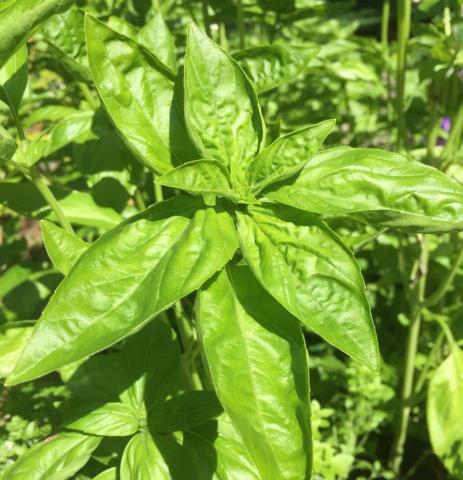
Photo: Genovese Basil
At this time of year, many gardeners have a bumper crop of basil. Maybe so much basil that it’s hard to find a use for all of it.
A relative of mint, basil is thought to have originated in India. There are several kinds of basil, but most of the time we see (and grow) either the Mediterranean Genovese or Globe varietals or the purple Thai basil.
Basil is usually added to recipes at the last minute (although there are several Asian dishes involving deep-fried basil leaves) and it doesn’t last very long after cutting. If you’ve cut more than you can use right away, you can preserve it in olive oil, which will yield a basil-flavored oil that can be poured over pasta or used in salad dressing.
A combination of chopped basil and chopped garlic preserved in olive oil is another option – not only do you get a nicely flavored oil, but the oil/basil/garlic mixture is good spread on bread or mixed with tomatoes to make a topping for bruschetta. (If you keep basil in oil, please be sure to refrigerate the mixture to avoid botulism. We want our readers alive and well.)
If you’ve got lots of Genovese basil, you can’t go wrong with a Caprese salad. Italian in origin, the salad was developed to mimic the red, white, and green of that country’s flag. You can stack slices of ripe tomato and Buffalo Mozzarella and deck the stacks with lashings of chopped basil and a little olive oil and vinegar, or you can make this less-fancy version. Basil is the natural ally of tomatoes, and if you have ripe tomatoes and basil in your garden you can simply serve a plate of sliced tomatoes with a scattering of basil, a little salt and pepper and a drizzle of Balsamic vinaigrette.
I can’t leave Genovese basil without talking pesto, which is maybe the most famous use of basil. For good reason. This is the recipe I use, which is pretty straightforward, and is freezable if you leave out the cheese (which you can add after thawing, if you like). If you have pesto, you have a sauce for your pasta, a spread for your bread, a topping for your homemade pizza, and I’m sure you’ll think of more uses.
If you’re growing Thai basil, you can use it in all sorts of curries, and it is a natural muddled into a mojito or mixed (sparingly) with sweet, fresh summer fruits like cantaloupe. You can also use this somewhat spicy variety of basil to make vegan, gluten-free Chinese Eggplant, which also makes good use of the eggplants that are starting to multiply in gardens and in Farmers Market Stalls.
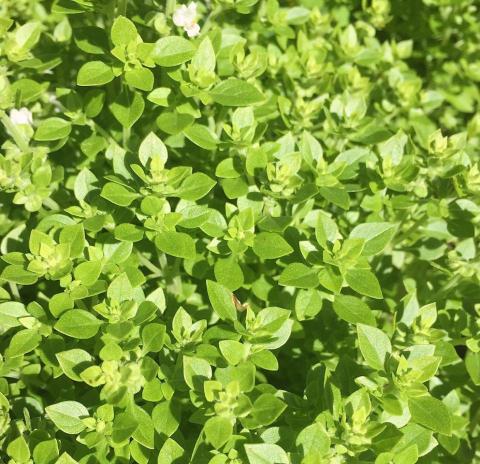
Globe Basil
And that Globe Basil? It’s also known as “Greek Basil,” and you can use it any time you would ordinarily use Genovese Basil; because its leaves are so small, you don’t need to chop them up for cooking. When I think of Greece, I think of Feta cheese, and you could easily whip up a Greek version of the Caprese with chopped, ripe tomatoes, crumbled Feta, a handful of Globe Basil leaves, and some oil and vinegar or purchased Greek salad dressing.
If all of this leaves you wishing you had more basil in your life, here’s a tip from gardener Aron Sousa, whose Genovese and Globe plants are pictured in this article: “You can grow it in a sunny windowsill over the winter. If you’re planning for next summer, it might help to know I start my garden basil by seed under lights in the basement or in the garden itself. If I start basil indoors, I start about five weeks before the last frost, so about late April. You can buy basil seeds on sale now — they will work fine next year — or you can also save seeds from your own plants and use those.”
eastlansinginfo.org © 2013-2020 East Lansing Info