
You are on eastlansinginfo.org, ELi's old domain, which is now an archive of news (as of early April, 2020). If you are looking for the latest news, go to eastlansinginfo.news and update your bookmarks accordingly!
You are on eastlansinginfo.org, ELi's old domain, which is now an archive of news (as of early April, 2020). If you are looking for the latest news, go to eastlansinginfo.news and update your bookmarks accordingly!
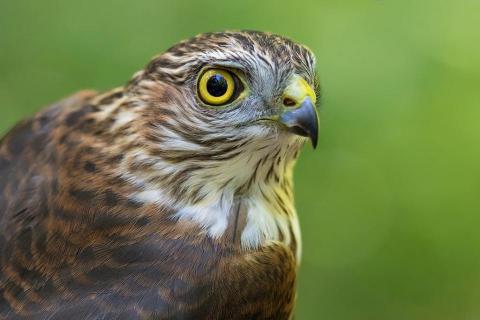
Photo: Sharp-Shinned Hawk, the smallest species of hawk in North America. It was netted at the station on September 22nd 2014. Photo credit: Zak Pohlen
Ever wonder how wildlife biologists track bird migration, net birds, or determine their age? Look no further than the Burke Lake Banding Station.
The banding station, located at the Michigan Department of Natural Resources (DNR) Rose Lake State Wildlife Research Area in Bath, offers the public an opportunity to get up close and personal with avian research conducted by Michigan State University during the spring and fall bird migrations.
The station started in 2010 as a strictly research-based facility, however due to public interest and funding from the Michigan DNR and public donations, the banding station has been able to remain fully open to the public since 2014. In addition to bird enthusiasts and the general public, many local schools and Michigan State University classes visit the station.
Common bird species that frequent the station include the Gray Catbird, Swainson’s Thrush, American Redstart, and the Magnolia Warbler. Just in the last two years the station has captured over 6,000 individual birds and over 90 different species.
At the station you are able to watch trained wildlife professionals net birds, measure and band them, and be released back into the wild. Each bird that is caught at the banding station is sexed, weighed, measured, and aged. A record of the birds overall condition, including how much fat they have and how much they weigh is the most important because it allows the staff to determine how well the bird is doing fattening up from migration and whether the Rose Lake State Wildlife Research Area has quality habitat for migrating birds stopping over prior to flying south for the winter.
Trained staff are able to age the bird based on its skull ossification. Birds that have hatched this year typically do not have a fully ossified skull, and birds over 1 year in age typically have a fully ossified skull. This is viewable by parting the feathers on the tops of their heads. The bird also receives a band around its leg with a unique set of numbers. The band serves as a record, and if the bird is caught later at the station or at another bird station information will be available on its overall health and age. Visitors are able to join the staff at the nets and are able to view the birds getting banded, but the public is not allowed to handle the birds.
The station provides the public an opportunity to learn about birds and it also provides students at Michigan State University a unique opportunity to get involved with avian research and to learn the necessary skills needed to handle birds up-close, a component missing from many wildlife courses.
The Burke Lake Banding Station is located in Bath 1 mile east of the Clark Road/Upton Rd intersection. The Station is open to the public until October 15th, weather permitting.
It is important to check the Station’s online calendar for days and times as it is updated frequently based on weather changes. Visitors are welcome to come and go at any time during the hours posted on their calendar, but it is highly recommended you come earlier in the morning because that is when most of the birds are captured.
To learn more about the station and how to get involved visit http://www.burkelakebanding.com.
eastlansinginfo.org © 2013-2020 East Lansing Info