
You are on eastlansinginfo.org, ELi's old domain, which is now an archive of news (as of early April, 2020). If you are looking for the latest news, go to eastlansinginfo.news and update your bookmarks accordingly!
You are on eastlansinginfo.org, ELi's old domain, which is now an archive of news (as of early April, 2020). If you are looking for the latest news, go to eastlansinginfo.news and update your bookmarks accordingly!
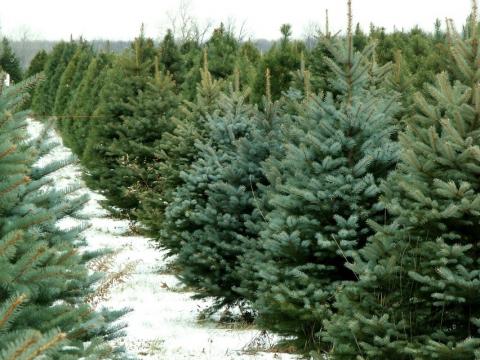
Photo: www.michiganagriculture.com
If you prefer to have a real Christmas tree there is no doubt about it Michigan is one of the best places to live. Michigan ranks third in the United States in number of Christmas trees harvested, and is home to over seven hundred Christmas tree growers.
Annually, 3 million fresh trees are harvested in Michigan for an estimated worth of $40 million dollars. Michigan historically led the nation in Christmas tree production, when Scotch pine was the most popular variety of Christmas tree; Scotch pines grow well in northern Michigan soils and climate, where traditional crops are not as viable.
Due to the improvement of artificial trees and changes in consumer preference of tree species, Christmas tree harvest in Michigan has declined. In more recent years consumer’s preference for Scotch pine trees has decreased, causing many Michigan Christmas tree producers to modify their operations. Michigan now leads the nation in the variety of Christmas tree species offered and consumers in Michigan are lucky to be able to choose from fourteen different Christmas tree varieties.
Consumers choose artificial over real trees for many reasons, including the environment. It’s important to consider a wide range of environmental impacts when weighing the pros and cons of artificial versus real Christmas trees.
Many consumers choose artificial trees out of guilt. The thought of cutting down a tree every year simply to decorate and recycle it seems wasteful. Others choose artificial Christmas trees due to the perception that Christmas trees are cut down from forests. It is important to note however that approximately 98 percent of all Christmas trees are grown on tree farms throughout the United States, and typically those farms cannot support other crops. Christmas trees are grown specifically to be cut down and decorated, and for each tree harvested one to three seedlings are planted in its place.
Oftentimes real Christmas trees can be recycled and reused for mulch, bird feeders, hiking trails, fish shelters, and more. Artificial trees are neither biodegradable nor easily recyclable and can even sometimes contain lead. They are generally made of polyvinyl chloride, or PVC, a product derived from petroleum.
Another factor to consider is greenhouse gas emissions and carbon sequestering associated with live trees. Around 85% of artificial trees are manufactured and shipped from China, usually on diesel-fueled ships. As a general rule of thumb it will take between eight and twelve years for an artificial tree to compete with the carbon benefits of a real Christmas tree, and the typical household replaces an artificial tree every six years. A single farmed Christmas tree absorbs more than one ton of carbon dioxide throughout its lifetime.
If real Christmas trees seem like too much work and artificial trees don’t appeal to you, consider a living, potted tree. They are gaining in popularity and can be purchased from many online retail stores.
When purchasing a living Christmas tree, bear in mind that the tree can only be inside for up to fourteen days. You do not want the tree to break dormancy and begin to grow because it is likely it will not survive if planted outside in winter. Another option is to keep the tree indoors and plant it in the spring. On a live tree, miniature lights are best as they give off the least heat.
eastlansinginfo.org © 2013-2020 East Lansing Info