
You are on eastlansinginfo.org, ELi's old domain, which is now an archive of news (as of early April, 2020). If you are looking for the latest news, go to eastlansinginfo.news and update your bookmarks accordingly!
You are on eastlansinginfo.org, ELi's old domain, which is now an archive of news (as of early April, 2020). If you are looking for the latest news, go to eastlansinginfo.news and update your bookmarks accordingly!
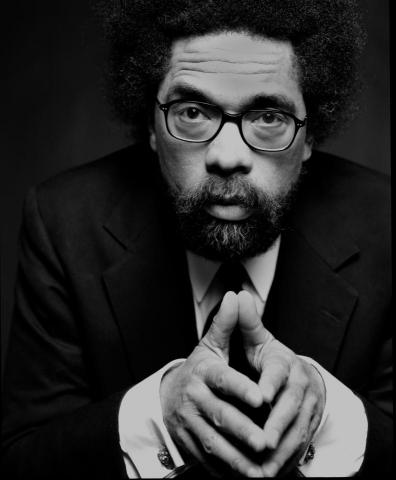
“It’s all about courage,” said Cornel West on Thursday, February 18th. At 5:10 people were still filing into the already-crowded Big Ten Room at the Kellogg Center to see and hear Dr. Cornel West.
His lecture, part of the month-long series From Slavery to Freedom: An American Odyssey had been scheduled to start at 5pm. Planning staff had set up the biggest room they had to prepare for the largest audience, but it still ended up being standing room only.
West, a prominent philosopher, social commentator and author, graduated Magna Cum Laude from Harvard in three years and achieved his MA and PhD in Philosophy at Princeton. He is currently a Professor of Philosophy and Christian Practice at Union Theological Seminary and Professor Emeritus at Princeton.
The evening’s program began with the African National Anthem and was followed by what is commonly known as “The Black National Anthem,” or “Lift Every Voice and Sing.” Dr. William G. Anderson, after whom the lecture series is named, then introduced Dr. West. In his introduction, he mentioned that West immediately agreed to come to MSU to be a part of the series once he heard what it was about. Once West took the stage, he added that this lecture series is the only one of its kind at a university.
Tradition was a major theme in West’s lecture. He began with, “I am who I am because someone loved me.” He grew up on “the chocolate side of Sacramento” with his mother and father. He stated that he would never compare to the man that his father was. He also drew from many notable African-Americans of the past who had worked to try to help those that were disenfranchised.
He went on to speak about love, injustice and tradition and their intimate intertwining, emphasizing that the leaders of the past would not be who they were or been able to accomplish what they did without the support and love that they were surrounded by. He referred to Martin Luther King, Jr, W.E.B DuBois, John Coltrane, Aretha Franklin, Thurgood Marshall, Anne Braden and Charles Hamilton Houston, among many others.
West also spoke about the current and past artists, musicians and traditions that are no longer prevalent. The Blues Tradition, the Soul Tradition and the number of artists continuing these traditions has dwindled, he said. He expressed nostalgia for those that previously embodied those traditions.
West specifically mentioned Beyoncé and noted that she is a great entertainer, but that she has very few soulful songs. He was congratulatory towards Jay-Z, Beyoncé and others who have achieved financial success, but added, “Money has taken over many of our young artists. Blues people cannot sustain themselves on superficiality and image.” He later remarked that he was impressed by Kendrick Lamar and most of all by his recent “powerful performance” on The Grammys.
West urged the crowd to consider W.E.B. DuBois’s “three questions,” as he addressed each one:
How shall Integrity face Oppression? “
West explained that Martin Luther King, Jr used to say one should always stand up straight with shoulders back because “folks can’t ride your back unless it’s bent.”
“Give up being great and focus on success” he advised.
What shall Honesty do in the face of Deception, Decency in the face of Insult?
West exhorted listeners to “be highly suspicious of deodorized or sanitized discourse.” Regarding Donald Trump, West stated, “he’s for real without being right.”
What shall Virtue do to meet Brute Force?
“Love is our tradition,” said West. “Over all these years of struggle and injustice, we as a people have never created an Isis or Al Qaeda.”
“We talk about the human connection,” he explained, “because the human connection is necessary to talk about black people.”
After West finished his lecture, he took many questions from the audience. One of the questions from an audience member was what actions could be taken to work for justice when they were personally challenged by prejudice and racism. West encouraged her to support alternative media that tells the truth instead of corporate media. “There’s no money in keeping track of integrity and truth.” he added.
Another audience member expressed feeling discouraged about the progress, or lack thereof being made in race relations in the US. West offered that “major victories at the legal level” should be remembered. He encouraged her to read biographies of W.E.B. DuBois, Thurgood Marshall, Charles Hamilton Houston and others who worked for equality and civil rights. He also encouraged everyone to participate, adding, “Democracy is not a spectator sport.”
The final questioner addressed what he felt to be the most racist and unequal grounds: the church. He asked, “How do we promote justice instead of being dragged by it?” West nodded his head and said “Lift your voice.”
Yesterday, February 25, the series concluded with Ernest Green, MSU alumnus and one of the Little Rock Nine. One of the first students to integrate Little Rock Arkansas’s Central High School in 1954, he and eight of his classmates later received the Congressional Gold Medal from President Clinton.
eastlansinginfo.org © 2013-2020 East Lansing Info