
You are on eastlansinginfo.org, ELi's old domain, which is now an archive of news (as of early April, 2020). If you are looking for the latest news, go to eastlansinginfo.news and update your bookmarks accordingly!
You are on eastlansinginfo.org, ELi's old domain, which is now an archive of news (as of early April, 2020). If you are looking for the latest news, go to eastlansinginfo.news and update your bookmarks accordingly!
East Lansing’s Financial Health Team has asked for a consultant to study a possible income tax for people who live and work in East Lansing. This is but one of many possible approaches being considered by the volunteer team of advisors as it tries to tackle the City’s budget woes.
At a meeting tonight at the Hannah Community Center, Financial Health Team (FHT) Chair Michael Moquin told residents that the work of the FHT is like trying to put together “a 500-piece puzzle that’s been dropped on the floor where all the pieces are facing downwards.” He said the FHT is still gathering information and that it is especially concerned with the question of how to meet promises made to past and current City employees with regard to their pensions and healthcare benefits.
Moquin told those gathered that the maximum amount that could be levied by the City of East Lansing on residents in the form of an income tax would be one percent, with a maximum cap of one-half percent for non-residents working in the city (including at MSU). Numbers are not yet available on how much revenue this might generate for the City. The City could also elect to have an income tax at a lower rate.
Moquin said he felt it important “to stress that the judgment to have an income tax is a political as well as an economic judgment.” He said the decision to try to impose an income tax would be made by City Council and would have to be approved by the voters. “So,” he said, “there will be plenty of opportunity to have wide-ranging discussions” before any such tax would be put in place.
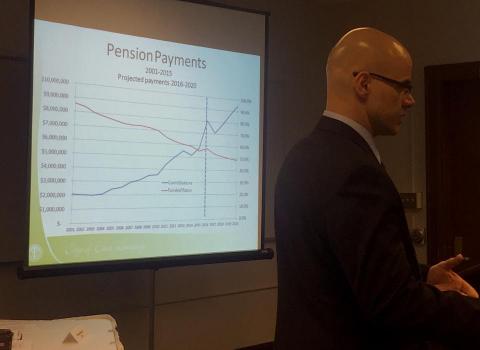
At the meeting, City Manager George Lahanas made a presentation of the City’s financial situation, using a series of charts to show just how serious the situation is with regard to mounting debt related to pensions and OPEB (“other post-employment benefits,” including health insurance).
Lahanas showed a chart (captured in the photograph above) that vividly illustrated that while contributions to the City’s pension fund have been going up and up—meaning the City is putting more and more money towards this expenditure—the funded ratio is going down and down—meaning that the City is falling ever further behind on meeting its obligations.
When asked by an audience member whether the extra $2 million payment diverted to the pension fund last year made any real difference, Lahanas said “it didn’t have the impact we hoped it would have.” The City is feeling the squeeze from being required by MERS (the Municipal Retirees’ Retirement System) to fund its pension debt on a shorter timeframe than previously employed. Retirees are also living longer than expected, which means more expenditure by the City for pensions and other retirement benefits.
According to Lahanas, the City currently has 272 active employees and is supporting 404 retired employees. One audience member asked whether “there any possible way to work with existing retirees to take a haircut”—in other words, could retirees be convinced to take less.
Moquin said that the “short answer is that it never hurts to ask, to have the discussion, particularly if the fund’s health is in peril.” But, he noted, the state constitution protects government retirees’ pensions; a City can’t simply decide to reduce retirement benefits without cooperation of the retirees.
One audience member objected that it was unreasonable to ask retirees to “take a haircut” if others, like developers, were not also asked to take a less sweet deal than they had been promised by the City. A number of audience members objected to tax subsidies to developers.
Questions from the audience included whether the City should keep working with MERS for its pension system. One commenter said MERS had been “asleep at the switch a long time,” which had led to the underfunding problem the City now faces. In response, Moquin, who worked for MERS previously, explained that it is legally and financially very difficult for a city like East Lansing to withdraw from MERS and use a different system.
FHT member Sue Haka reminded citizens that today’s was the first of a series of “citizen engagement meetings” to be held by the FHT. The next such meeting will be on Wednesday, June 29 at 6:30 p.m., also at the Hannah Community Center. According to the City, that meeting “will serve as a forum for community members to share their ideas and feedback.”
Want to learn more about these issues? You can read ELi’s reporting on:
eastlansinginfo.org © 2013-2020 East Lansing Info