
You are on eastlansinginfo.org, ELi's old domain, which is now an archive of news (as of early April, 2020). If you are looking for the latest news, go to eastlansinginfo.news and update your bookmarks accordingly!
You are on eastlansinginfo.org, ELi's old domain, which is now an archive of news (as of early April, 2020). If you are looking for the latest news, go to eastlansinginfo.news and update your bookmarks accordingly!
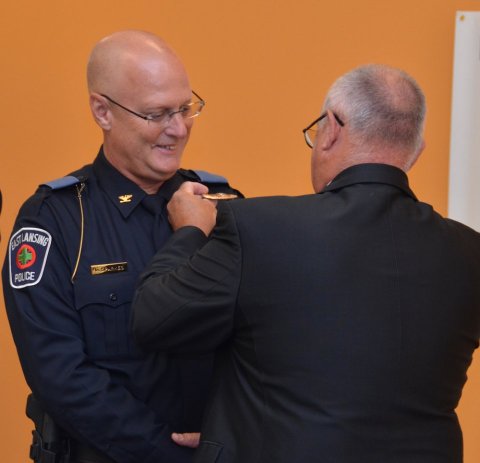
Above: East Lansing Police Chief Larry Sparkes when he was sworn in.
East Lansing Police Chief Larry Sparkes told the Council of Neighborhood Presidents last night that a recent media reporting claiming that 22 home invasions happened over the Labor Day weekend was “simply not true.” The actual number was four.
The wrong number came from Lansing-based TV news station WILX talking to an MSU student who lives on M.A.C. Avenue, who told the reporter, “There are 22 houses that got robbed on this street, or something like that.”
WILX talked to the police for the story, but did not get the correct number.
Last night, Sparkes explained what really happened on Labor Day weekend. In the 400 block of Charles Street (an area heavy in student rental houses), a resident came home to discover four strangers on the back porch of their house. That person called in a likely burglary, while the four strangers took off running.
When police arrived, nearby residents came to tell officers they also had just had break-ins. The police went to work and caught two of the four thieves breaking into another house. They had the stolen property with them.
“So we solved three crimes very quickly,” Sparkes explained, “and brought a lot of the valuables back [to the owners] quickly.”
Sparkes told neighborhood leaders who gathered last night for the monthly meeting at the Hannah Community Center that the number of home invasions in East Lansing has been going down year by year.
In 2013, there were 164 burglaries in East Lansing. In 2016, the number was down to 126, and in 2017, it was down again, to 109.
Nevertheless, Sparkes said, it’s still very important to lock doors and first-floor windows and to lock cars. Many thieves, he said, are opportunists who will take advantage if they find an unlocked door, and move on if they don’t.
Burglaries happen more when there’s a lot of activity in neighborhoods, like during student move-in/move-out periods and during big MSU games. These events create what Sparkes called a “target-rich environment” for people looking to commit crimes.
Asked what ELPD is doing to reduce crimes during big-event weekends, Sparkes explained the Department increases staffing on those weekends “to the best of our ability,” and puts officers on bikes and on foot, because they can more easily arrive to possible active crime scenes without being heard in advance.
Asked about staffing levels, which had been down to a bare minimum due to budget problems in the City, Sparkes said he now has five officers plus a supervisor on duty for each ordinary shift. (That’s up by one officer per shift.) He said that he hopes to add “a couple of officers [to the force] by the end of the year, or by early 2019.”
He said the plan was to use extra available funds to hire more police officers rather than PACE (code enforcement) officers. Several neighborhood leaders indicated they agreed that was the right choice.
Hawk Nest President Anne Hill asked what she should tell residents of her neighborhood who say they don’t want to lock their doors because they’d prefer a theft to a theft plus a broken door that needs replacing. Sparkes said residents need to understand that locked doors and windows and locked cars really do tend to push thieves along.
“They are looking for the path of least resistance,” he said.
Hill followed up by saying an ELPD officer had helpfully explained to her that a neighborhood known for a lot of unlocked houses and cars becomes a “magnet.” So, a pattern of neighbors generally locking houses and cars can help push thieves away from a neighborhood.
Sparkes replied the reputation of an area does indeed impact the likelihood of crime. He gave this as an example:
A few years ago, thieves were robbing people on the street in East Lansing, to take their phones and wallets. ELPD had worked with the Lansing Police Department’s Violent Crimes Initiative unit to develop a plan to put plainclothes officers in high-crime areas. After using these undercover police to catch criminals, the word got out, and the type of crime dropped in East Lansing.
Some neighborhood leaders asked about the demographics of thieves committing crimes in East Lansing. Sparkes said they are generally young (about age 22 and younger) and live locally – not in other parts of the state, as some rumors suggest – generally coming from the greater Lansing region.
I asked Sparkes about why we sometimes see a bicycle apparently abandoned – unlocked and laying down – along a sidewalk or street corner. Could these be for staging crimes, or abandoned after being stolen, for some reason?
Sparkes said it “could be about stashing merchandise,” but regardless of why the bicycle is there, it should be reported to ELPD. ELPD will secure the bicycle and try to get it back to its rightful owner.
Doug Couto, President of Walnut Heights, talked about package thefts that occurred especially over the winter holidays in his neighborhood, along with break-ins.
Sparkes replied that ELPD recommends that residents who are going to go away for a period call and notify the police so that the police can check on the house.
Couto, who served as Chair of East Lansing’s Citizens Innovation and Technology Panel, also asked about cybercrimes. Sparkes said the key to that problem is not giving out personal information, particularly from unfamiliar people calling by phone.
A number of neighborhood presidents asked for additional traffic patrols in their areas to slow down speeding drivers. Diane Wing of Chesterfield Hills specifically asked for help for her neighborhood as it faces innumerable cement trucks traveling from Lansing to downtown construction sites on Grand River Avenue.
“Anything to keep that traffic down to 35 [mph, the speed limit] would be a godsend,” she told Sparkes.
He replied that he had taken notes on all of the requests at the meeting and would convey them to his staff to see what could be done for specific concerns.
Note: When this story was published, we quoted Sparkes saying that those committing crimes here generally come from the local area, including from west of East Lansing, but we did not make clear that he had been specifically responding to a resident who asked if they come from the southeastern part of the state, as the resident said he had heard. In response to a reader question about this, Sparkes clarified for ELi that he simply meant that people caught committing thefts in East Lansing generally come "from the greater Lansing region," so we changed the line to make that clear.
eastlansinginfo.org © 2013-2020 East Lansing Info