
You are on eastlansinginfo.org, ELi's old domain, which is now an archive of news (as of early April, 2020). If you are looking for the latest news, go to eastlansinginfo.news and update your bookmarks accordingly!
You are on eastlansinginfo.org, ELi's old domain, which is now an archive of news (as of early April, 2020). If you are looking for the latest news, go to eastlansinginfo.news and update your bookmarks accordingly!
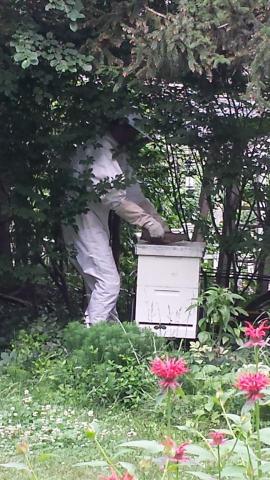
Bees are high-profile creatures these days, and one (tasty) way to help them to thrive is to become a backyard beekeeper.
At times referred to as the “angels of agriculture,” honey bees pollinate millions of crops per year and an estimated one in three bites of food you eat. Unfortunately, their populations have declined dramatically in recent years due to habitat loss, deforestation, industrial agriculture, parasitic mites, and Colony Collapse Disorder.
Honey bees are eusocial insects, meaning they have cooperative brood care, overlapping generations, and a division of labor within their colonies. Honey bees can be divided into three categories: the queen, female workers, and male drones. The queen leaves the hive once in her lifetime to mate with several drones. Worker bees help rear and defend the eggs laid by the queen and collect nectar that will eventually become honey. The hive is made up of many generations, younger ones tend to the queen and older bees forage for food, construct wax cells, convert nectar from flowers into honey, and guard the hive from intruders. In the summer honey bees have a life expectancy of 45 days, however in the winter they can live much longer.
The art of beekeeping dates back hundreds of years, and references to honey bees can even be found in rock art in Africa, India, and Spain. While not native to North America, honey bees were introduced in the 17th century. We have since grown accustomed to honey in our diets, and use beeswax in many other products including cosmetics and candles.
Honey bees generally travel up to 2.5 miles from their hive to forage for food. A honey bee’s diet is made up of three components: water, carbohydrates acquired from nectar, and protein acquired from pollen.
Honey is produced by bees as a food source during the winter and food shortages. Working together bees use “honey stomachs” to ingest and regurgitate nectar and store it in honeycomb cells. Bees fan their wings to reduce the water content of the nectar, ultimately raising the sugar concentration and preventing fermentation. A beekeeper can expect to harvest roughly 100 pounds of honey per hive in a year, according to Terry Toland, president of the Michigan Beekeepers Association and avid beekeeper.
There are 50 to 60,000 bees per hive during the summer months, and usually 10 to 20,000 in wintertime. Bees spend their winters eating honey and clustering in the middle of the hive, twitching their muscles to keep the queen warm at a toasty 95 degrees Fahrenheit. A warm queen ensures new offspring during springtime.
“While native flowering plants are important for bees, so are many trees including basswood, black locust, and maples” Toland explains, “because trees are so large, they produce a lot of pollen, making them excellent food sources for bees. While some people may think of dandelions and clover as weeds, they are some of the most important flowers for honey bees because of their bloom time, length, and availability.”
“The easiest way to learn about beekeeping is to join a local club, experienced hobbyist enjoy teaching beginners and are a wealth of knowledge,” recommends Toland, “starting with two colonies is best, if you make a fatal mistake you have one to fall back on.”
Beginners can expect to pay around $500 for two colonies and supplies, which can be found in kits. A package of starter bees costs around $100. It’s also important to purchase personal protective gear including a suit, gloves, and a smoker.
“One of the best things about beekeeping is that you can decide how much you want to learn. Some beekeepers just scratch the surface, while others explore bee biology and genetics. It can be as simple or as complex as you want it to be,” says Toland.
To learn more about honey bees, their biology, and how you can get involved visit the Michigan Beekeepers Association at www.michiganbees.org.
eastlansinginfo.org © 2013-2020 East Lansing Info