Monday, August 31, 2015, 7:00 am
Living sustainably, or being “green” reduces your use of Earth’s natural resources, and means changing how you look at many parts of your life including transportation, energy consumption and diet.
Interested in beginning a sustainable lifestyle or amping up what you already do? Below is a list of simple things you can do around the home to become a bit more “green.”
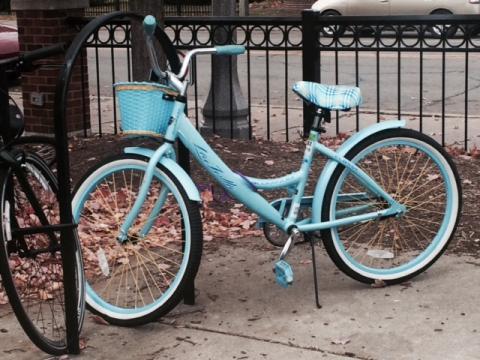
- Get a bike. We’ve all heard that driving less is better for the environment because it uses less gas, creates fewer harmful car emissions, and is less expensive. Getting a bike doesn’t mean you should get rid of your car, it’s simply one way you can reduce your usage of fossil fuels. Is it really necessary to drive two blocks away to pick up a gallon of milk? Probably not. Plus, cycling has many health benefits.
- Compost. Put your organic food scraps (egg shells, potato skins, banana peels, etc.) into a perforated composting pail, and tuck it away under a sink or in the corner of your kitchen. (Read here about a local service that will take pretty much everything you produce in your kitchen). A 2012 paper by the Natural Resources Defense Council estimated that as much as 40% of America's food supply ends up in a dumpster. One of the biggest problems with food waste is that landfills with decomposing food release methane, a harmful greenhouse gas. The Natural Resources Defense Council estimates that landfills produce a quarter of our country’s methane emissions.
- Install a faucet water aerator. This almost invisible faucet attachment adds air to the water, without decreasing water pressure. They can be purchased at a local hardware store for as little as $4.00. The Environmental Protection Agency (EPA) estimates that if all homes in the United States installed faucet aerators over 64 billion gallons of water would be saved annually.
- Buy Energy Star appliances. Energy Star is an EPA voluntary program. Appliances that have the Energy Star Label meet specific energy saving standards. Find a list of products at www.energystar.gov.
- Buy advance power strips. TVs, computers, printers, monitors, cell phone chargers, and many other handy electronic devices draw energy even when not in use by simply being plugged in. This is commonly referred to as “vampire load” and cost the average home over $200 annually according to the U.S. Department of Energy.
- Lower your water heater temperature. Most manufacturers automatically set hot water heater thermostats to 140 degrees F, but most households only require them to be set at 120 degrees F. Turning down the heat reduces standby energy loss (heat lost from the tank into the surrounding area) and consumption (water demand). Turning down the heat can save an estimated $450 annually in consumption and energy loss, according to the U.S. Department of Energy. Reduced water temperature also slows mineral buildup, corrosion of pipes, and reduces the risk of scalding.
- Install energy efficient lightbulbs. The variety of energy efficient lightbulbs is almost endless, and there really is no good reason to use traditional incandescent lightbulbs any longer. Halogen incandescents, compact fluorescent lamps (CFLs), and light emitting diodes (LEDs) have all been shown to use 25-80% less energy than traditional bulbs and last 3 to 25 times longer. Initially they are a bit more expensive than traditional bulbs (especially LEDs) but they use considerably less energy and last much longer.
- Mow your lawn with a reel lawn mower. They are cheaper (gas, oil, spark plug free), great exercise, safer than traditional power motors, and quieter allowing you to mow your lawn whenever it is most convenient for you. A typical gas powered lawn mower running for one hour produces as much air pollution as a sedan traveling two hundred miles, according to the EPA. Reel mowers are not for everyone however, they are best suited for yards less than a half-acre in size. They also do not work well for very bumpy or overgrown yards.