
You are on eastlansinginfo.org, ELi's old domain, which is now an archive of news (as of early April, 2020). If you are looking for the latest news, go to eastlansinginfo.news and update your bookmarks accordingly!
You are on eastlansinginfo.org, ELi's old domain, which is now an archive of news (as of early April, 2020). If you are looking for the latest news, go to eastlansinginfo.news and update your bookmarks accordingly!
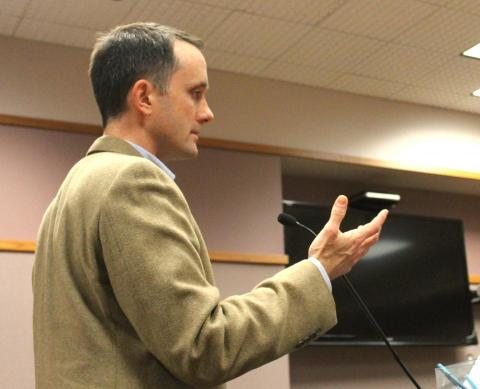
Image: Tim Dempsey speaking at an earlier City Council meeting
Last night at City Council, Planning Director Tim Dempsey told Council that city staff planned to “button up” (i.e., finish) the draft development agreement between the City and PDIG today and to give it to the Downtown Development Authority (DDA) for their review tomorrow. Following citizens demanding adequate review of the track records of the owners and managers of PDIG—the controversial development company seeking to build a 10-story building at the corner of Abbot Road and Grand River—Dempsey presented a new approval process plan and told Council that outside review by legal, real estate, and financial consultants will come later, after site plan and special use permit approval. (ELi has obtained a copy of Dempsey’s flowchart; see it here.)
Crouch Investment Group, majority owner of PDIG, is managed by Scott Chappelle, the principle of Strathmore Development Company, which failed to bring the last project at this site (known then as City Center II) to fruition. Citizens have been raising concerns over Chappelle-associated company track records of failed projects, foreclosure actions, contractor liens, lawsuits, etc.. PDIG is seeking over $35,000,000 in public financing incentives, and the project requires that the City sell or transfer two valuable pieces of publicly-owned land to PDIG. The deal is much larger than any ever made by the City and, some say, extremely risky to the City's financial and social future.
Dempsey presented Council with a hardcopy of a flowchart that indicates that “due diligence” will come after Council approves the site plan and special use permit for the building, and that the “due diligence” will involve “(1) Real estate/financial consultant reviews [of the] financial structure and brownfield plan; (2) Outside legal counsel reviews [of the] ownership structure, development agreement, and related documentation.”
During public comment, Jay Brant said he thought the City needed outside help to understand the economic feasibility of this plan. Brant said he has been a litigator with major Michigan law firms “for twenty-plus years,” and that he has seen “what happens at the back-ends of these projects . . . when things go wrong.”
Brant told Council, “Without due diligence, cities can easily be left with more blight than they started with, because the developer, and more particularly the people behind the developer, don’t have the expertise and experience to bring it off.” He noted that “PDIG has no track record” and said “there’s a reason for that,” i.e., that it’s a limited liability corporation specifically created for this project.
But, Brant said, that the City could look at the track records for the people involved with PDIG and ask about their track records “for developments around the state or around the country.” He closed by saying, “I would submit only by doing this can you really protect the city going forward.”
Don Power spoke for the PAC Neighborhoods 1st. A former City Council member, Power demanded Council and staff undertake a maximally-transparent and extensive “due diligence” on PDIG, its lead personnel, and its financial and legal situations. He asked Council to get three questions answered: (1) “Who are we dealing with?” (2) “Do they have solid access to funds for this project?” If not, why not? (3) “Are they reliable? What is their track record?” Power also objected to any use of public funds in the form of Tax Increment Financing (TIF) or brownfield funding. He indicated he believes it is time to stop funding private development with public money.
Ralph Monsma, another former City Council member, also spoke during public comments. He said he continues to oppose the plan for the building because it is too high-risk. He questioned the economic marketability and sustainability of the building’s plans for tenants, and also questioned whether the parking and traffic plans are rational. He asked “why not something smaller and more doable that isn’t as fiscally constrained?” He said there is a lot of “opportunity for failure” in this plan.
Monsma named as another concern the continued lack of details in the site plan application. He questioned the developer’s claim that the building must be ten stories to be economically feasible, and wondered whether this means the plan is financially marginal in terms of economic sustainability. He said to the Council that they must “look out for the people of East Lansing, and know your developer.”
Mark Sullivan, Co-Chair of East Lansing Citizens Concerned, spoke to the question of whether the proposed building really provides “public benefit” as it is supposed to under its request to go above the zoning limit of eight stories to ten. He mocked the idea that the building would “diversify housing” by, according to the applicant, providing “upscale amenities not typically found in undergraduate student housing such as: valet parking; room service; dry cleaning pick-up and drop-off; onsite banking; restaurant and coffee shop; and concierge service” as well as “hardwood or stained concrete floors, stainless steel appliances, and large easy access closets.” (See the developer’s whole letter here.)
Sullivan told Council, “This is supposed to be promoting diversity of housing? This is total nonsense.”
Sullivan further noted that, while the applicant takes credit for the plan to “upgrade and realign Albert Avenue; add bike lanes to Albert and Abbot Road; add traffic lanes to Abbot Road; and modernize and increase capacity of electrical, water and sewer facilities,” in fact all of this work will be paid for by the city.
Sullivan told Council he is “heartened at the prospect of Council recommending we seek outside additional assistance” and said it was a “very positive move.”
No one spoke in support of the project during public comments.
During the Council's discussion of the site plan for “Building A,” several Council members questioned whether the applicant has evidence for “public benefit” and for the claim that the building is not feasible at eight stories. They asked for more data.
Councilmember Kathy Boyle also asked why the building’s apartments cannot be developed under the tenet of universal design. The architectural representative of the developer, Todd Arend of Bergmann Associates, did not seem to understand what universal design is. He said they would manage disability accessibility as code requires, which is a signifcantly lower and different standard than universal design. Boyle's interest seems to be in making the building amenable to seniors who might wish to live in the upscale, downtown apartments.
Council unanimously elected to defer further work and discussion of this project to the January 27 work session of Council.
UPDATE: January 14, 12:55 pm: The opening of the second paragraph was corrected to note that Chappelle is the manager of Crouch Investment Group, majority owner of PDIG. (Details here.) We do not know who is the manager of PDIG.
ELi is a reader-supported, nonprofit, noncommercial news source for the people of East Lansing. Without reader donations, ELi cannot operate. Donate online or donate by check. Your contributions are tax deductible!
eastlansinginfo.org © 2013-2020 East Lansing Info