
You are on eastlansinginfo.org, ELi's old domain, which is now an archive of news (as of early April, 2020). If you are looking for the latest news, go to eastlansinginfo.news and update your bookmarks accordingly!
You are on eastlansinginfo.org, ELi's old domain, which is now an archive of news (as of early April, 2020). If you are looking for the latest news, go to eastlansinginfo.news and update your bookmarks accordingly!
Tensions with electrical utility provider Board of Water and Light (BWL) remain high in parts of East Lansing, especially in old-growth neighborhoods like Oakwood (where I live) and Glencairn. But at a recent Oakwood potluck, I talked to a neighbor who has had overall a positive experience with BWL coming to trim his family’s trees. So I asked that neighbor, Nate Stevenson, to share his story with our readers.
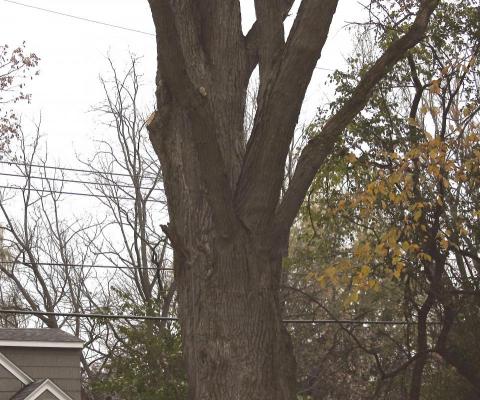
Stevenson understands why BWL is looking to cut, saying he and his wife Jenny also “want to be sure that we don't lose power unnecessarily.” But, he adds, “we also don't want to jeopardize the life of a massive oak that remains one of our favorite things about our property. We also didn't want to create an eyesore. A bit of trimming needed to be done, particularly two large limbs that extended over [a neighbor’s] house.” But the Stevensons didn't want to give BWL permission to do whatever its trimmers wanted without further discussion.
Stevenson lives on Marshall Street with his wife Jenny and their children in a home typical of the area: close to neighboring houses, about a century old, with many period details including a covered front porch that extends all the way across the front of the house. Like many homeowners in this area, the Stevensons have opted to turn their front yard into a garden with a large variety of plants, and their property is clearly part of what is referred to as East Lansing’s “urban forest,” a forest that includes towering old oaks, maples, hickories, as well as many shorter trees--including many “volunteers” that, through years of neglect, have grown too close to power lines.
I asked Stevenson what his experience was with BWL in terms of communications back and forth, since communication breakdown has been cited as a problem in BWL customer relations. He described it as “generally very slow,” saying that when he called the office of vegetation management supervisor Diana Paul, “I got the general office voicemail all but 1 time (6 out of 7 I think). Wait time for a call back was usually 4-7 business days. I finally scheduled a consultation about two weeks out. The Friday before the appointment, [Stevenson’s spouse] Jenny received a call from Ms. Paul's office inquiring about what time the appointment was scheduled. This really confused me because I never gave them Jenny's phone number. I'm not sure why they didn't call me. I'm also not sure why they were aware of the appointment date but not the time.”
Diana Paul and BWL's arborist John Rademacher arrived on time and together BWL staff and Stevenson “looked at the one tree of major concern. The arborist indicated all of the limbs that would need to be cut. The proposed cutting would have made the 200+ year old oak tree very lopsided.” Stevenson says the BWL team had proposed eliminating every branch growing on the northwest, north, and northeast side of the tree.
Stevenson “indicated that I was uncomfortable approving that much trimming both for aesthetic reasons and for the health of the tree. I was very clear that I wished to be as conservative as possible with regard to which branches would be trimmed.”
BWL explained that the company would not use a contractor but would send a crew of BWL personnel, except for outside alpine specialists hired to deal with the very high branches. BWL asked if Stevenson wanted to be at the property when the crew came to cut, and he said “definitely.” They scheduled a time for the following week.
Stevenson told me, “BWL came to the door when they arrived. Jenny consulted with them about which branches we approved to be cut. The BWL crew indicated that they were supposed to cut many of the branches further up, consistent with their 10-foot radius that is stated in their policy. However, they said that they would only cut what we approved and stated that if their bosses insisted on trimming those which we did not approve, then BWL would contact us for another consultation prior to any further cutting.”
The crew removed smaller trees, with trunks ranging in diameter up to three inches, that were directly beneath the power lines or had branches threatening to tangle with the lines. Says Stevenson, “They chipped most of the small stuff and cut the larger pieces into chucks that could be split.” Since the Stevensons have a gas fireplace, they gave most of the wood to a neighbor who uses wood for heat.
“In the end,” Stevenson says, “it wasn't as bad as experience as I've heard from others. Though the communication latency was a problem, every time we spoke to an actual person, interactions were very reasonable and cordial from crew members on up to supervisors.”
When I asked Stevenson to give advice to others facing trimming or removal of trees by BWL, he replied: “Be courteous. Though I was very worried about my tree, BWL trimming practices, BWL policies, and the like, I was patient, calm, and courteous throughout the process. I made my feelings clear but was certainly not rude or forceful. In return, BWL was respectful throughout the entire process (aside from the delays in communication).”
This week, Lansing voters approved a charter amendment allowing “three advisory non-voting representatives of customers and citizens outside the City of Lansing” to participate in BWL Board of Commissioner discussions, including one “appointed by East Lansing.” That representative has yet to be named.
To read about why Lansing controls BWL, and thus ultimately controls electrical service to many citizens of East Lansing, click here.
Disclosure: Alice Dreger lives in East Lansing and is a BWL customer. Although the trees of her property are not affected by BWL's vegetation management program, the trees of her immediate neighbors are.
eastlansinginfo.org © 2013-2020 East Lansing Info