
You are on eastlansinginfo.org, ELi's old domain, which is now an archive of news (as of early April, 2020). If you are looking for the latest news, go to eastlansinginfo.news and update your bookmarks accordingly!
You are on eastlansinginfo.org, ELi's old domain, which is now an archive of news (as of early April, 2020). If you are looking for the latest news, go to eastlansinginfo.news and update your bookmarks accordingly!
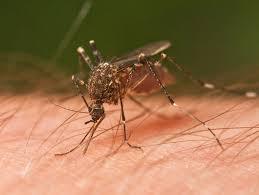
The Zika virus was raised as a concern during a discussion of mosquito abatement at last week’s City Council meeting. The virus is not expected to reach East Lansing this summer but the latest research shows an increased risk throughout the lower Midwest and southern New England.
On April 12, the Center for Disease Control released maps showing the paths of the aedes aegypti and aedes albopictus, the species of mosquitos carrying the virus which has infected thousands in South America. The most recent map of the potential reach of the Zika virus shows Michigan just north of the farthest path of the least likely of the two mosquito carriers.
Michael G. Kaufman, professor of entomology at Michigan State University, said the least common vector, aedes albopictus (Asian tiger mosquito) has established itself in northern Ohio and will likely see established populations in southern Michigan in the near future. However, the vector more commonly associated with Zika, the aedes aegypti (Yellow Fever mosquito), are unable to tolerate even a mild winter so aren’t likely to come to Michigan until dramatic climate warming has occurred.
“If Zika is going to be a concern, it is only in the southern regions of the U.S.,” said Dr. Kaufman. “We certainly aren’t going to see any in the East Lansing area.”
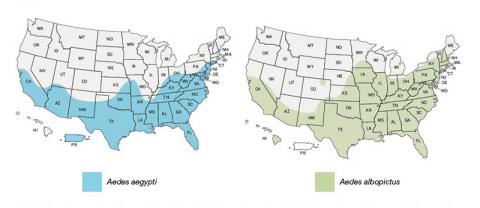
Image courtesy of the CDC
The Zika virus is especially concerning because it has been associated with birth defects, including microcephaly, in infants born to women who are infected with Zika while pregnant. It originated in Uganda and has been established in the tropical western hemisphere. While most infections occur through mosquito bites, there have been limited evidence that it can also be sexually transmitted.
As of April 6, there have been 346 cases of Zika virus disease in the U.S. – all of them travel associated. Of those 32 include pregnant women and seven were sexually transmitted. One patient contracts Guillain-Barre syndrome as a result of the infection. Two of the infected patients live in Michigan.
Dr. Kaufman said if Michigan were to see any locally afflicted residents, it will almost certainly come from sexual contact with someone who was infected during travel.
“The risk here of actually receiving it through a mosquito bite is almost nonexistent,” he said. ‘If we do see a local case, I would bet it was sexually transmitted.”
He compares Zika to illnesses such as yellow fever and dengue, both of which are transmitted by the same species of mosquitos and has never gotten a foothold in the region.
“This is not West Nile which moved from birds to mosquitos to people,” he said. “We don’t know for positive that the native mosquito species can’t spread these but we are pretty certain. They don’t feed the same way, for one thing.”
For a more detailed look at the life cycle of mosquitos, please read Aron Sousa’s article which ran in East Lansing Info on July 20, 2015.
Meanwhile, President Obama has asked Congress to approved $1.9 billion to combat the outbreak. At a recent press conference, a deputy director for the CDC said “everything we look at with this virus seems to be a bit scarier than we initially thought.”
MSU Extension recommends awareness and the sensible use of chemical repellents to prevent all mosquito-borne disease including West Nile virus.
For more information about the federal government’s efforts to track and combat Zika, go to this page.
eastlansinginfo.org © 2013-2020 East Lansing Info