
You are on eastlansinginfo.org, ELi's old domain, which is now an archive of news (as of early April, 2020). If you are looking for the latest news, go to eastlansinginfo.news and update your bookmarks accordingly!
You are on eastlansinginfo.org, ELi's old domain, which is now an archive of news (as of early April, 2020). If you are looking for the latest news, go to eastlansinginfo.news and update your bookmarks accordingly!
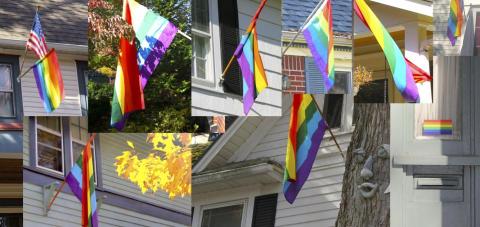
Image: Rainbow flags on East Lansing homes
As Christopher Behnan reported last month for the Lansing State Journal, the national LGBT rights organization Human Rights Campaign awarded East Lansing a perfect score in its 2014 Municipal Equality Index (MEI). The MEI “examines the laws, policies, and services of municipalities and rates them on the basis of their inclusivity of LGBT people who live and work there.” East Lansing was the only Michigan city to earn a 100-point score. Ann Arbor rated 83, Detroit 75, and Grand Rapids 59.
The MEI looks at laws, policies, and services—not lived experience. So to get a sense for our readers of the lived experiences of LGBT people in East Lansing, I polled an unscientific sample of five LGBT East Lansing residents. I asked about whether those surveyed feel safe in East Lansing, whether they feel their children are safe, how they might be made to feel more welcome, and so on. Here are the responses.
Do you live in East Lansing, rather than in a nearby or far away city, because you feel safer or happier here as an LGBT person? Is there somewhere else you’d rather live in terms of your experience as an LGBT person?
Most of the respondents said they live here because of proximity to work, although the generally-welcoming attitude of East Lansing factors in as a positive.
A good example here is the response from Stephen Thomas, who has lived in East Lansing for 10 years (previously in Oakwood and now Chesterfield Hills). Thomas is on the Zoology faculty of MSU and is a member of ELi’s Board of Directors. He says that he and his husband “chose to live in East Lansing because of proximity to work, but also because it is so welcoming.”
Kath Edsall, a member of the East Lansing Public Schools School Board, has lived in East Lansing for 17 years but has been in the general area since arriving as a freshman in 1978. She is a partnered lesbian woman who lives in the Flower Pot (Red Cedar) neighborhood and says, “I have recommended East Lansing, in particular our neighborhood, because we have experienced nothing but acceptance as a white lesbian family with African American kids by adoption, plus many pets including chickens.”
Jamie Lindemann Nelson has lived in East Lansing since 2000, and resides in the Glencairn neighborhood. She is a transgender woman and a professor of philosophy at MSU. She explains, “I live here because I work here,” but adds “I’m pleased to work in a place where, so far as I’ve experienced, general attitudes seem to range from respectful to indifferent.”
Ruth Beier, City Council member and labor economist for the Michigan Education Association, identifies as a member of the LGBT community and says, “I live in East Lansing because people here are smart, interesting, and generally on my side of the political spectrum. My orientation has no impact on my decision to live here.”
Do you feel it is safe (physically, psychologically, etc.) for you to be out in terms of your LGBT identity in East Lansing? Do you feel safe having your neighbors know your identity? In terms of strangers you might encounter at local businesses, at doctors’ offices, City Hall, on the street?
Edsall says, “I am out to everyone or anyone that I encounter and don’t really worry about their reaction or acceptance. I assume I will be treated like everyone else and, at least to my face, I am.” She explains, “We moved into East Lansing, the Flower Pot in particular, for more racial, cultural diversity for our children, in particular in school.”
A more qualified answer to this came from Terry Scharf, Beier’s partner. Scharf is a nurse who has lived in the Lansing/East Lansing area for about 30 years and identifies as a gay person. Scharf says, “I feel it is physically and psychologically safe for me to be out as a gay person in my neighborhood here in Oakwood and I felt the same living in the Flower Pot.” She adds, “I feel reasonably safe in most other East Lansing areas because I trust that people here will refrain from overt discrimination or harassment even if they feel uncomfortable around me. There are a few areas in East Lansing that make me feel uncomfortable.”
Of her experiences in East Lansing, Nelson said, “so far, so good.” When asked if she would recommend East Lansing to an LGBT person who was thinking of moving to the area, she said she would “be willing to share my to-date positive experiences about East Lansing in general.”
Thomas told me, “I feel very safe in East Lansing and have no hesitance to discuss being gay or mentioning my husband with businesses, plumbers, or doctors’ offices. Neighbors have been extremely friendly and inclusive.”
Thomas said that if an LGBT person were moving to the area, he’d recommend East Lansing “or places like the West side of Lansing.” He notes that in some cities, “There are specific areas…that have high densities of the LGBT community, but in East Lansing the community seems more integrated into the general population.”
He did add: “One issue with being in a college town is the fear that students might get out of hand and act inappropriately. Case in point, since being here in East Lansing, I have been yelled at a half-dozen times from passing cars, but to date the worst thing that has been yelled was, ‘You’re old!’” He adds, “I can live with that.”
Do you feel it is safe for your children to be known at school as being children of an LGBT person or an LGBT couple?
Scharf says that if she had school-aged children, she would be “afraid they could be victims of bullying if it was widely known they were from an LGBT family.”
Scharf’s partner Beier recalls that when they were raising their children together, “they risked ridicule because we didn’t have the money to take them on spring break trips or keep them in fancy clothes. Our sexual orientation never came up. Like other parents, we old people were not interesting enough to the kids and their friends to rise to the level of ridicule. Our kids were known as Chris, Amy, Pat, and Judy, not the children of an LGBT couple.”
Edsall was the only person I polled who currently has children in public school here. She and her partner have eight children, including two who had their K-12 education entirely in ELPS and five who are currently enrolled in ELPS. She says, “They all choose when they feel comfortable outing their family but my partner and I have never been anything but out when interacting with teachers, principals, and administrators. Most of our kids are out to their friends and most of their friends are comfortable hanging out at our home. We were sadly disappointed when a previous administration cancelled a diversity club at the middle school when one parent complained about GLBTQ issues being discussed.”
Are you aware that we have an out member of the LGBT community on East Lansing’s City Council (Ruth Beier), and does that make a difference to you?
Thomas said he didn’t know “and it does make a difference because of the representation as well as signaling a larger acceptance of LGBT members.”
Nelson said she is “very glad that Ruth Beier is part of the government of this city,” and Edsall said she is “thrilled that Ruth is on City Council.”
Scharf jokingly said, “I am aware that East Lansing Council member Ruth Beier is openly gay since we live together and she is my partner.” On a more serious note, she added, “To tell the truth, it sometimes makes me concerned that we could be targeted for criticism or harassment by anti-gay individuals or groups.”
For her part, Beier says, “The ‘gay council person’ thing seems so contrived. . . . Why would it matter that I am a City Council person and I am gay? Why do the two facts belong in the same sentence? I don’t ‘represent’ gay people. I represent everyone.”
Could East Lansing be more welcoming?
Scharf said she “would like to see some rainbow flags and window stickers in downtown establishments. That would make me feel very welcome.” Neslon agreed that would “be nice—though also a reminder of one’s welcome being in question.”
Thomas points out that East Lansing “has multiple churches that have open and affirming policies for LGBT individuals that provide loving communities to help them grow spiritually and raise their families. For example, Edgewood Congregational Church runs or participates in events such as Family Pride Picnic, Lansing Pride festivals, and the Lansing Area AIDS Walk, and pastors and many lay leaders are [or] have been LGBT.”
Of course, when you live in East Lansing, you don't live in a bubble. A couple of those polled mentioned that while East Lansing may be a safe and welcoming location, the State of Michigan provides a different, more hostile context. That context includes, for example, having a governor who has signed legislation banning domestic partner benefits for state employees and defended a statewide ban on gay marriage.
On December 26, 2014, this article was changed to correct the spelling of Edsall's last name.
ELi is a reader-supported, nonprofit, noncommercial news source for the people of East Lansing. If you want us to keep bringing you news like this, contribute now! Donate online or donate by check. Your contributions are tax deductible!
eastlansinginfo.org © 2013-2020 East Lansing Info