In the Wild

You are on eastlansinginfo.org, ELi's old domain, which is now an archive of news (as of early April, 2020). If you are looking for the latest news, go to eastlansinginfo.news and update your bookmarks accordingly!


ASK ELI TO INVESTIGATE: Unidentified Pink Object

Friday, October 17, 2014

On Fridays, ELi runs a feature called Ask ELi to Investigate in which we answer a question from a reader. Last week we answered a question about BWL finances. Several readers have submitted other important political and economic questions, and we are working on those and will bring you answers in the coming weeks. As we work on those, this week we offer you a lighter Ask ELi.

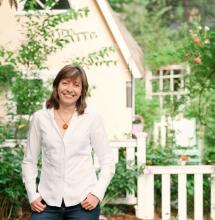
A Word from Our Publisher

Saturday, October 4, 2014

Photo credit: Jenny Stevenson Phtography

EastLansingInfo.org (ELi) has been up and running for about a month and the response has been tremendous! People all over town are sharing our articles and are talking about how refreshing it is to have an independent, nonpartisan news source focused on our otherwise-overlooked small city. The excitement is palpable, and the level of participation is terrific!

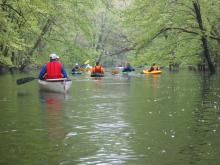
Looking Glass Logjams Cleared, But More to Do

Saturday, October 4, 2014

A float in a canoe or kayak just a few miles north of East Lansing on the Looking Glass River conjures up wilderness areas one might associate with being “up north”—except there are usually more buildings on the rivers up there. It is not uncommon on a paddle along the Looking Glass to see no other human for hours at a time. What you often will see are sandhill cranes, kingfishers, cedar waxwings, great blue herons, woodpeckers of multiple species, muskrat, and the occasional raccoon enjoying an afternoon nap in a snag.

Monarchs Eat in East Lansing during Trip to Mexico

Wednesday, September 17, 2014
East Lansing monarch butterfly sips nectar from an area zinnia

Each fall, monarch butterflies (Danaus plexippus) from East Lansing fly south to the Mariposa Monarca Biosphere Reserve in Mexico. Butterflies that mature during the late summer in East Lansing and other habitat east of the Rocky Mountains migrate thousands of miles south to overwinter in the Mexican bioreserve before heading north again in the spring. They get as far north as the Great Plains before laying their eggs and dying. The Great Plains’ offspring of the East Lansing original butterflies then continue the species’ migration north, back to the northern habitat.

Deer Encroachment and Damage in East Lansing Neighborhoods

Thursday, August 21, 2014
Ray Vlasin shows the damage caused by deer to a tree in his yard

On June 19th representatives from seven neighborhood associations came together at a meeting hosted by the Harrison Meadows Association. The other six neighborhoods participating were Walnut Heights, The Crossings, Shaw Estates, Whitehills, Abbott Parkside, and Pinecrest. They heard from Cathy DeShambo of East Lansing Public Works who is leading the city’s response to problems caused by growing deer herd size and encroachment into the residential neighborhoods of the city.  These problems include health and safety concerns and widespread property damage.

With Deer Come Tick-Borne Diseases

Wednesday, August 20, 2014
A field team associated with Dr. Hickling collects and analyzes ticks

This is an interview between Alice Dreger for ELi and Dr. Graham Hickling, an ecologist at the University of Tennessee who specializes in emerging wildlife diseases and their interface with humans and domestic animals. Hickling is a former resident of East Lansing and he continues to collaborate with faculty and students from Michigan State University to conduct annual fieldwork in Michigan. This interview, conducted by email, has been lightly edited for clarity with the final version approved by the interviewee.

Nunica Turkeys Duke It Out

Monday, November 26, 2012

Now that Thanksgiving has passed, we can count on our local turkeys to make more turkeys for next year, but not without the usual struggle: here's a picture sent to ELi by way of Jim Robertson "of two male turkeys 'duking it out' for the benefit of their potential mates this spring in Ottawa County near Nunica." Credit for the picture goes to Robertson's colleague Michael Hambacher.

Favorite EL Places: Baker and Sanford Woodlots

Monday, October 22, 2012

Editor's note: We are starting a new series at ELi called "Favorite EL Places." Submit yours! (And supply a photo, or ask us to arrange one to go with your submission.)

My name is Champ, and I live in the Bailey neighborhood. I want to tell you about me two favorite places in East Lansing: the woodlots on campus. Baker woodlot is along the Red Cedar River, near MacDonald and Holmes halls. Sanford woodlot is between Farm Lane and Bogue Street, just south of Service Drive (near the Clinical Center).

There are many things I love about these woods, but the best is that it's LEASH OFF! They are fenced, so my friend Smitty doesn't have to worry about me running into a road (sometimes when I'm in hot pursuit of a squirrel, I forget to look....). And speaking of squirrels, it's terrier heaven. They are everywhere! There are also other critters to chase like chipmunks, birds, etc. One day, I treed a woodchuck! And once in a while, I chase deer. Oh joy! But I get a little nervous about those hawks. I'm a little guy, and they always look hungry. I'm not afraid (did I mention I'm a terrier? we don't do afraid), but still.

Quick Local Leaf Peeping Trip

Saturday, October 6, 2012

For a brief but pretty drive-by leaf-peeping trip, consider an excursion by way of south campus and east to Meridian Road. There are farms, open fields flanked with maples, pumpkins, teaching cows and teaching sheep, and a whole lot of bull.

Salmon Time on Campus

Friday, October 5, 2012

Dateline: Red Cedar River, MSU Campus, Thursday, October 4. Salmon spotted engaging in behavior of a suspiciously flirtatious nature.

I have been watching for salmon the last couple of weeks and was wondering if the river was too low this year. Some years I have seen none and have heard no reports of any this far upriver. However, this is about the usual time for a first sighting.

I saw activity both behind Kellogg and from the Library bridge, my usual observation posts. A few times I have seen them jumping at the falls by the Administration Building. They are probably more plentiful behind Kellogg, but the Library bridge, on both sides, when the light is right and the river calm, so you can see bottom, provides the best viewing. There is a shoal on the northwest side of the bridge where females dig in to lay their eggs, and a few years ago one stayed in a shallow along the southwest bank for almost a week. Today there was no visible entrenched female laying eggs. Of course, mostly what you see is frisking and chasing, males, being males. Be patient. Sometimes it takes a few minutes of watching, and there may be as many as half a dozen coming and going in the vicinity. If at first you don't succeed....

Even if the result is a wild salmon chase, the salmon run is a good excuse for a river walk during peak colors on days with no beer tents. In addition, over the last week, I have seen two herons at the same time behind Kellogg during midday, and one heron toward evening by the falls.

Update, at 3:30 Friday: saw a female digging in the silt on northeast side of bridge. No camera, but pointed out to a student with telephoto taking fall pictures, who took several.

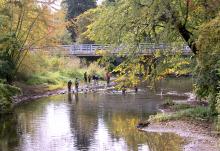
Note on image: While we were not able to get a shot of the salmon, we did get a shot of MSU fisheries students in a research class catching salmon, which they were then returning to the water.

Fall Colors Day Trip

Saturday, September 29, 2012

It is fall migration time, and a great place to view migrating waterfowl, as well as trumpeter swans and other permanent residents, is the Kellogg Bird Sanctuary, part of MSU's Kellogg Biological Station near Battle Creek. If you are lucky, on an October backroads drive to and from, you will see sandhill "cranes in the air," circling by the hundreds to land on a harvested cornfield. Sign up for the KBS e-newsletter, or check the website and online calendar, to keep up with special events.

A visit to KBS is a good way of shaking off the winter in April, when there are often peacocks wandering the grounds, doing spring mating displays, and a wide variety of migrating ducks on Wintergreen Lake. But KBS makes an especially nice fall color day-trip. There are shorter routes (which will show up if you seek online directions), but our favorite (about 1.75 hours each way) is leisurely and pretty and allows for a stop at the Country Mill on the way back. Bring food and drink and hand-cleaner (there are picnic tables outside the bird sanctuary).

Here's how we go:

Great Blue Heron Sighted Tailgating on Campus

Saturday, September 15, 2012

Around 2 pm today, while tailgaters were beginning to assemble for the Notre Dame night game, a great blue heron was spotted fishing in a rapid on the Red Cedar River, at the corner of Michigan and Harrison, by the Kellogg Center. I saw it catch a gulp-sized fish (with larger fish, herons have to turn them around in their bills, which is fun to watch). This is the first time I have seen a heron on campus since May, I presume because of the heat and the low water level in the river. Most years, I make frequent heron sightings from May through September.

Northern Pleasures: Touring Tips

Thursday, August 30, 2012

Editor's note: Pictures from Eliot Singer follow his text.

I grew up in Boston in the '50s and '60s with fall color trips, just as far as the wilderness of Walden Pond when very young, graduating to Vermont and New Hampshire and then to autumnal hikes with my father or college buddies in the White Mountains. My wife and I were married on Mount Washington during late-September peak colors.

Pages

eastlansinginfo.org © 2013-2020 East Lansing Info