
You are on eastlansinginfo.org, ELi's old domain, which is now an archive of news (as of early April, 2020). If you are looking for the latest news, go to eastlansinginfo.news and update your bookmarks accordingly!
You are on eastlansinginfo.org, ELi's old domain, which is now an archive of news (as of early April, 2020). If you are looking for the latest news, go to eastlansinginfo.news and update your bookmarks accordingly!
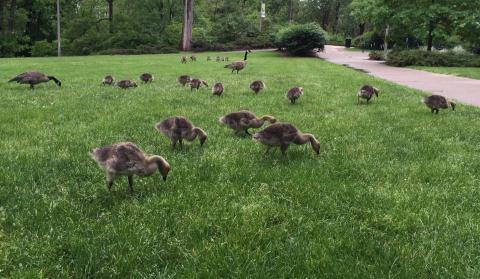
Above: Canada Geese adults and goslings yesterday on the MSU campus near the Red Cedar River
Spring is a time of graduation and, over the last several weeks, the young of East Lansing, outfitted in their youthful finery, have been trying out their wings and leaving the nest. Fledging and immaturity are risky times for young birds, as for all young animals. Sharp-eyed East Lansing residents may come upon young birds in the community this time of year as they try out their new environments.
A good place to look for birds in the area is the Red Cedar River running through Michigan State University. The campus provides good access to humans and excellent habitat for a variety of interesting birds, including kingfishers, heron, and—downstream, this year—eagles. Ducks and Canada geese are also plentiful. This weekend, the author found six adults minding nearly 20 goslings from this year’s hatch. (Story continues after video.)
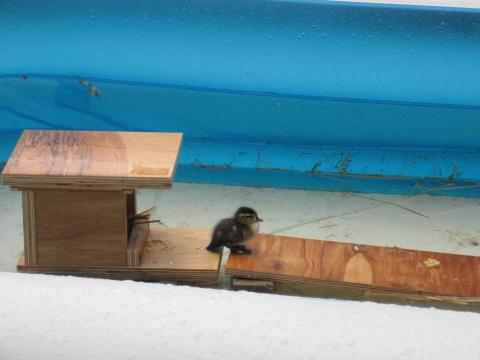
There are plenty of ducklings down by the Red Cedar River this time of year as well, but sometimes residents run into ducklings well away from the river. This year and five years ago, wood ducks nested in the Oakwood Neighborhood just north of Valley Court Park. In nature, wood ducks nest in tree cavities (or nest boxes) well off the ground. Very soon after they hatch, wood duck chicks climb out to the nest, jump to the ground, and waddle to the nearest water. Oakwood is probably not a good choice for nesting given the number of cats, raccoons, roads, and hawks between the neighborhood and the Red Cedar.
Below is a photo showing a wood duck chick the author rescued from neighborhood cats five years ago and kept safe for a few days before taking it to a duck sanctuary. (Story continues after photo.)
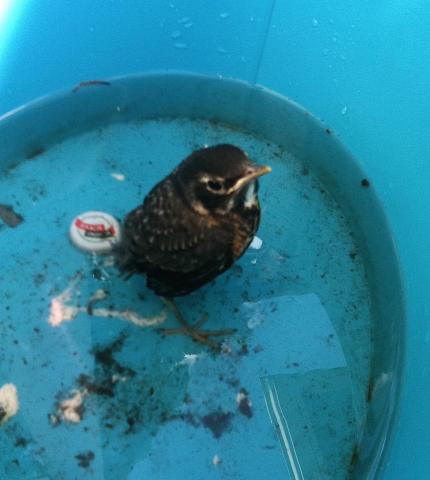
Robins nest very near the houses of East Lansing and are attracted to the bugs and worms that live in gardens and lawns of local houses. When robin hatchlings are about two weeks old, they fledge and leave the nest. The first flight can be difficult and dangerous if the young bird lands in a place it cannot fly out of or into the path of outdoor cats, foxes, or hawks.
The photo below shows a fledgling robin whose first flight ended up in an ice bucket on the author’s back porch. The parents of this bird were very angry when the author reached in to free the fledgling. (Story continues after photo.)
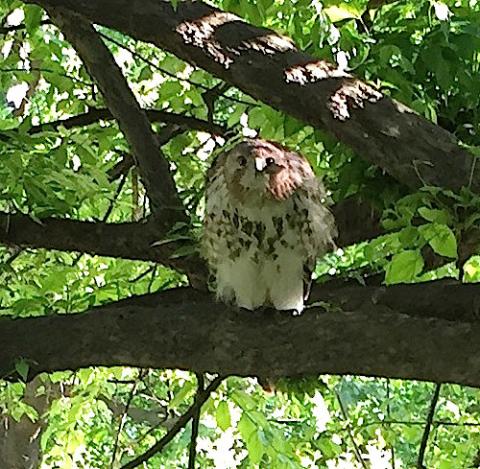
Not all young, immature birds in East Lansing are from this year’s hatch. There are at least two immature hawks making their home in the area. The juvenile red-tailed hawk pictured below was seen in a crab apple tree in MSU’s Beal Garden and has been making the rounds of good hunting perches around the Circle drives of campus. This bird was most likely hatched and fledged last year and has yet to develop the markings of a mature hawk.
eastlansinginfo.org © 2013-2020 East Lansing Info